• Welcome to this forum . We are a worldwide group with a common interest in Birmingham and its history. While here, please follow a few simple rules. We ask that you respect other members, thank those who have helped you and please keep your contributions on-topic with the thread.

    We do hope you enjoy your visit. BHF Admin Team

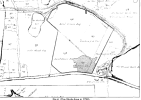
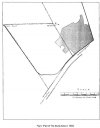
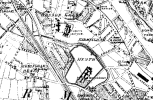
the workhouse ground

There may of course be artifacts scattered around that area from the building of the canal and bridge.

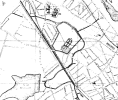
The canal line passing under Lea Bridge seems to be a 'new line'. Was that a new branch of the canal or a redirection ? In any case, the creation of this new route must have produced much industrial/canal construction activity in the mid/late 18th century, albeit it a little distance from the later infirmary/workhouse.
Yes Viv, the new line canal cut a straight path in to Birmingham. Built by Thomas Telford it removed the summit at Smethwick and three locks and it left the Soho loops that used to follow the contours.
 
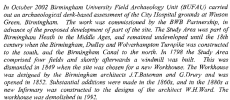
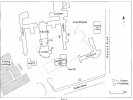
In 2003 some work was undertaken in the grounds
2003 pits.jpg
The report concluded that:
No archaeological features or deposits were identified that pre-dated the Workhouse
and associated buildings, and no structures were identified that were not previously
highlighted within the desk-based assessment.
The structures identified correspond to the ex1stmg maps and plans of the old
workhouse, hospital complex and associated buildings. The Workhouse was
demolished in 1992 (Hislop 2002). The depth to which the walls survive suggests that
the preservation ofthe remains relating to the rest of the Workhouse is good.
 
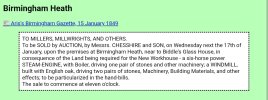
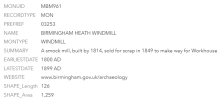
This must be the sale of the windmill in 1849. Sounds like a mill for grinding grain. It was around for about 50 years and must have moved with the times if it was (converted ?) to steam power. Could it have been an early steam driven mill ?
Screenshot_20261008_153151_Chrome.jpg
 
Last edited:
I'd put money on Boulton and Watt having an interest in the mill (or even instrumental in its conversion to steam) especially as Soho House being not far away.
 
The mill may have only existed for at least 35 years looking at tge derails in post #42 - a very short time. But the extract attached to post #32 puts it at an earlier date, existing for some 50 years.

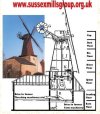
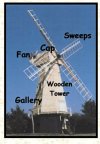
And I've just noticed the use of 'smock mill' in Janices's extract in the post above. They had brick foundations, but given that the mill was sold in entirety, the archaeologists would never have uncovered anything from beneath the workhouse. Here's a description of a smock mill:

A smock mill is a type of windmill with a stationary, sloping wooden tower—usually with six or eight sides—topped with a rotating cap that turns the sails into the wind.

Design and Structure

• Name origin: The multi-sided wooden body looked like the traditional cloth smocks worn by farmers.
• Tower construction: Built around a wooden frame and covered in weatherboard, clapboard, or thatch.
• Brick base: Often set on a brick foundation to protect the timber from ground moisture and rot.
• Rotating cap: Only the top roof portion turns to catch the wind, unlike older post mills where the entire building rotates.
• Corner posts: Heavy interior corner posts (called "cant posts") angle inward as they rise to support the structure.

History and Uses

• Origin: Developed in the Netherlands during the early 16th century.
• Primary use: Originally used to pump water and drain wetlands, and later adapted for grinding grain into flour.

 
Last edited:
Back
Top