• Welcome to this forum . We are a worldwide group with a common interest in Birmingham and its history. While here, please follow a few simple rules. We ask that you respect other members, thank those who have helped you and please keep your contributions on-topic with the thread.

    We do hope you enjoy your visit. BHF Admin Team

no wonder they have to build up

Astoness

TRUE BRUMMIE MODERATOR
Staff member
hi folks i have been on my favourite map site again travelling around birmingham visiting different roads and streets where the houses are long gone..many of them good sturdy houses that could have been saved .. as an example i have photo here of the corner of claremont road and soho hill close to where i grew up so i put it in the map search box then moved the blue dot to the left to see what was there today..its just amazing to see how many houses and buildings we have lost all over birmingham due to new roads being built..where these buildings were is where the duel carriageway is now..today there is just not enough ground space for new houses so they have to build up as high as they can and put people in boring dull drab high rises that nobody wants or can afford especially those with young children ..no gardens no neighbours to pass the time of day over the garden fence.. no corner shops..no pubs no community spirit...all i can say is thank god i grew up with all that and i find it so sad that in some ways the way people live now has not changed for the better and yes we must have progress but at what cost..just my own thoughts sorry for the moan :rolleyes:i will shut up now :D ..below is the photo i mentioned and also below the link to the map site showing the position of the photo..just move the blue dot to the left..pretty sure on the right of the photo i can see the roof of the palladium cinema on soho hill which is just about still standing

lyn
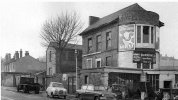


claremont road and soho hill corner.jpg
 
Last edited:
hi folks i have been on my favourite map site again travelling around birmingham visiting different roads and streets where the houses are long gone..many of them good sturdy houses that could have been saved .. as an example i have photo here of the corner of claremont road and soho hill close to where i grew up so i put it in the map search box then moved the blue dot to the left to see what was there today..its just amazing to see how many houses and buildings we have lost all over birmingham due to new roads being built..where these buildings were is where the duel carriageway is now..today there is just not enough ground space for new houses so they have to build up as high as they can and put people in boring dull drab high rises that nobody wants or can afford especially those with young children ..no gardens no neighbours to pass the time of day over the garden fence.. no corner shops..no pubs no community spirit...all i can say is thank god i grew up with all that and i find it so sad that in some ways the way people live now has not changed for the better and yes we must have progress but at what cost..just my own thoughts sorry for the moan :rolleyes:i will shut up now :D ..below is the photo i mentioned and also below the link to the map site showing the position of the photo..just move the blue dot to the left..pretty sure on the right of the photo i can see the roof of the palladium cinema on soho hill which is just about still standing

lyn


View attachment 217305
The loss of thousands of perfectly useable terrace houses and buildings is one of those things I too have a bee in my bonnet for. Like everting else there is never a single explanation.

I will say the main culprit was a change in how councils were funded in the mid-50s. Government subsidies were paid per house built, whether it was a new build on greenfield land or a replacement for a demolished slum. A significant change introduced a new, much higher subsidy only for new dwellings built to replace demolished slum dwellings. This made clearance and rebuild far more financially attractive to cash-strapped councils than renovation or building on new land. It set a "bonus for bulldozing.

If we add to this the fresh start clean sweep ideology following the war, it became fashionable to aim for modern living standards. It made the dense street patterns of terraced hosing, including sound houses obsolete. A lot of good houses was declared unfit for human habitation with an emphasis on demolition rather than improvement.

Of course, with all this new demand for new housing local people were sold the idea of the high-rise as a way of saving land. While this was true to a degree, cost was a major hidden driver.

With time being linked to cost, some of the big players in the construction industry sold the ideas of “system-built housing” using pre-fabricated concrete panels. The likes of Wates, Laing, and Bison promised councils rapid low-cost construction.

With the government pushing density targets to promote compact city’s and protect green belt land high-rise was an easy way to meet targets.

Unfortunately, what actually got built was by far removed from the promised dream home. Instead, local people got speed over quality and the construction of housing that was unsuitable for families. Social Isolation and design failures with the odd high rise building collapsing and housing with an astonishingly short life span.

Ironically, I have just driving past some new builds at the top of Highgate Road and Moseley Road that looked remarkably like good old, terraced houses.
 
I have to agree Lyn, in the area of Aston where I lived our back2back was completely serviceable, we had no damp and I only ever saw 1 rat. My uncles house around the corner was also in good condition.
I've never understood how they replaced these with flat-roof houses it must cost the council a fortune in maintenance.
On the image attached you can see the state of one of these houses, the house roof next to it has been recently renewed. I wonder how many times this has had to be done since the 60s.

I do realise that we were probably one of the lucky families though and there wer far worse living conditions.
 

Attachments

  • roof.jpg
    roof.jpg
    61.5 KB · Views: 4
Back
Top