• Welcome to this forum . We are a worldwide group with a common interest in Birmingham and its history. While here, please follow a few simple rules. We ask that you respect other members, thank those who have helped you and please keep your contributions on-topic with the thread.

    We do hope you enjoy your visit. BHF Admin Team

Measurements

  • Thread starter Thread starter V70PDB
  • Start date Start date
They like using them. Remember much of what has been used in mobile phones communications and some computer software has been in use by hams for well over fifty years. I had digital modes of communication in 1983.
 
They like using them. Remember much of what has been used in mobile phones communications and some computer software has been in use by hams for well over fifty years. I had digital modes of communication in 1983.

Nowadays you use your computer to send emails. Many early desktop computers had the facility to send and receive telex messages through the teleprinter network.
The computer museum at Bletchley has moved along the road from Bletchley Park but the first time I went to Bletchley Park I did make the comment that you feel you age when you see in a museum machinery that you actually worked on. I saw teleprinters like I used to type on and there were mini computers where I had to explain what each cabinet did and why they had tape drives!

A company I worked at in the 1990s had a comp on the top of one of the cupboards in the accounts department, They used to employ an elderly lady to come in to calculate the stock sheets at stocktaking times. That company ran on Lotus 123 spreadsheets (remember them?) but it took me, a temp at the time, to come in and put it on a spread sheet.
 
The company I worked for used Lotus 123 and I still use it for spreadsheets .... mind you I can remember using Visicalc when the size of hard drives were measured in Mb ... :D
 
This theme has brought back two memories, the first occurred in about 1964, the construction company I worked for had an early Xerox photocopier. This was regularly serviced and for about two weeks our regular service man was replaced by a different chap, so when our regular man returned and we of course jeered about holidays to be quickly shot down by a retort that as a senior Xerox employee, he had been to America to Xerox's home to look at the world of photocopying etc in the future. What had amazed him most of all was a telephone that sent facsimiles of letters etc to a similar phone hundreds,thousands even tens of thousands of miles away. An additional useful feature was that it could be used as a photo copier as well. Years later the fax was commonplace, but this lead to the second memory, our photocopier man was an early electronics buff, he had built his own radios and television and being friendly with the Burroughs rep, whose machines we used suggested that we became the first firm in Plymouth to computerise. The actual idea that the staff of twelve that ran accounts, wages etc could be reduced to probably two, but also all the bills of quantity could also be handled by one person, instead of the dozen QS, comp ops etc who currently did it. Came the day of the presentation, premises examination etc and these smart young Americans, came in looked at our prewar buildings which were near the sea and announced that the top floor which held the two luxurious main directors offices, the less affluent offices of the two sons of the main director who were also directors, the company secretary's office, the accounts office, my office (wages and personnel) and a store room. All as you might realise a considerable amount of building, should be stripped, the windows blocked off on the road side of the building, air conditioning installed and special doors fitted which also allowed only a minimal amount of personnel into the computer room. Having measured the length of the top floor and consulted his book of server pictures, he announced that there was just enough room to instal the servers and all the associated equipment and that for about £275K, we could become the first construction company in the South Western counties to fully computerise all our accountancy and estimating operations, rid yourself of at least 15 staff overall including QS's. He paused smiling, anticipating an order....our managing director was a very religious man, who eschewed drink, gambling and even courtship between staff members, he once sacked a foreman and telephone operator who he caught 'in flagrante' in a store room and never swore, went pale, silent and started to breathe heavily...there was silence he then turned on his heel and left. A very puzzled Burroughs man said "what have I done or said the remaining senior director said 'dared to suggest that you moved him out if his office, turned walked away and as he got to his office door looked back and said
'At 50K you might gave stood a chance walked in a closed his door. Two years later we went bust 1967......forward to 2017 and I received a letter to say that I was entitled to a pension of £36.45 a year before tax.
Bob
 
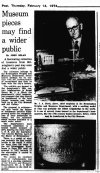
The W&M Dept (at one time in Broad Street) once had in its posession a 1674 bronze bushell - hopefully it eventually found its way to the Museum. A poor picture, but its supposed to show the (alledged) model of the worlds first weighbridge, located at the old Birmingham workhouse, Snow Hill. Screenshot_20260325_080215_Chrome.jpg
Source: British Newspaper Archive
 
I worked for Bryants in the 70's. They were constructing parts of Chelmsley Woods at the time. And on Area 13a they constructed a block of houses which were Metric - the rest being imperial. The first in the UK we who worked on the block were told.
There was much pomp and ceremony. Chris Bryant came out to the site with people from the City Architects department, including Mr Maudsley and Aldm Beaumont-Darke buried a folding 6ft imperial measuring staff in the raft foundation of the block before any superstructure was buit.
I was the Site Engineer responsible for setting out the block (placing the block on the ground from the architects plans) and getting all of the foundation work in. It was my responsibility to get it set out to metric measurements.
I took pictures on the day so sadly I am not in any but I have pictures of the men involved in the construction and pictures of the day they buried the staff.
You can see them here on my blog here...

https://bartonsbirmingham.blogspot.com

Any comments would be welcome.
Peter Barton
I know it's a long shot and the original poster was a guest who may not even use this site anymore.. but does anyone have any information on where this first metric house in Chelmsley was? I'd love to know. Thanks all.
 
Im just thinking out loud here and am wondering if there was ‘first’ metric house? I know on a lot of the social housing development sites in the very early 70’s there was a compromise of metric as near as dam it imperial materials used. One such place was Frankley Beeches where I was dealing with maintenance. It was a pain as within this transitions, there were some very odd sizes of timber doors and frames, a sort of halfway house.
 
Its never been straightforward in my memory. In imperial, if you asked for a piece of 4 be 2 (4x2) then sawn would be 4 inches by 2 inches. If you said PAR (planed all round) you got 3 7/8 inches by 1 7/8 inches.

Today’s almost equivalent is 47x 100 sawn or 44x94 PSE Timber = Planed Square Edge.

To clarify there is also 45x95 C16 which is a graded timber for stud work.

In America all lumber, as it is called there is measured in 1/4" units, so 1 inch is 4 quarter
 
Back
Top