• Welcome to this forum . We are a worldwide group with a common interest in Birmingham and its history. While here, please follow a few simple rules. We ask that you respect other members, thank those who have helped you and please keep your contributions on-topic with the thread.

    We do hope you enjoy your visit. BHF Admin Team

Hiroshima

  • Thread starter Thread starter Beryl M
  • Start date Start date
B

Beryl M

Guest
Hiroshima at 62 With Time Running Out

The atomic bomb with the strange name of "Little Boy" ushered in the nuclear age when it created an instant hell on earth at Hiroshima on August 6, 1945. Now, 62 years later, with the proliferation of nuclear weapons states and threats of producing new nuclear bombs, we must collectively pledge and demand the dark nuclear cloud hanging over humanity be eradicated through the rapid and total elimination of all nuclear weapons from the face of the earth. No politician in any country should be elected to a high office without making this pledge
 
Nice sentiment but the fact is nuclear weapons have kept us free of a third world war, without them I can think of many what we call small wars that would have led to a major conflict.

Feel free to disagree.
 
I know I am a bit of an idealist –when in retrospect I wonder how many elected who to high office would keep their pledge. .

If the sovereign nation of the United States of America were about to be violently overthrown, we have no doubt that tactical nuclear weapons would be deployed against the invading forces, and perhaps the capitals of those forces would be flattened by nuclear bombs.-

What may be used as a show to deter others can be misunderstood as a quest for global domination, and to humble the powerless . . . If the existing nuclear powers were serious about nuclear non-proliferation, they would minimize their atomic thresholds to levels that nobody might feel humiliated from.

Please don’t get me wrong. I’m not a dove, I don’t believe in pacifism and think free nations need to be strong to be respected, and that such strength includes military power.

(Each year on August 6th the news media pictures, stories and editorials, tell of the horror of the US using atomic bombs. We see the photos of Japanese victims, dead and alive, their scars tainting the morality of the bomb's developers, but where are the photos and details of our veterans' graves and those still living with the horror of mortal combat with, and imprisonment by the Japanese including some of those in my dad’s 605 Squadron?

For sixty-two years since winning this war for a meaningful peace, misinformed persons over the world accept from an unapologetic Japan, its ongoing despicable campaign to lament, decry, and condemn atomic death at the hands of the United States of America. . . But where is the cry to remember history's fanatical and depraved acts of a militaristic Japan killing and raping its way conquering all of Asia... before the bomb was dropped? )

However, it was a different time in history and one we will never forget. . .

Strength is a composite beast, and most of a country’s strength is actually educational, environmental and economic parameters. In that very context, engagement is seen as the far more promising approach compared to military threats.

Then, there is also a consistency problem. Why should Iran feel threatened, if other aggressive dwarf countries such as Pakistan, Israel and North Korea are allowed to get away with atomic non-proliferation?

I wonder myself, how my above thinking could be applied in the current Iran crisis. Well, let’s look at the crisis from an Iranian point of view. Why shouldn’t the country have nuclear power and weapons? Other economic Mickey Mouse countries as the mentioned North Korea, and Pakistan, enjoy the bomb. Isn’t it great to have parades on the main plaza with tanks and rockets? It helps a lot to boost morale, particularly when the kids at home have nothing got to eat, and the totally failed and corrupt governments have lost sight of the last economic silver lining.

Nuclear weapons are, in many ways, like the desperate barking of a hungry and weakened stray dog.

This said, the future Iranian bomb has a particularly worrying aspect.

What to do? Classical appeasement has failed already. Yet, continuing persistent engagement (rather than sabre-rattling) is seen as the only option. Facing continued deafness, the event of a total oil embargo should be flagged. Last not least - it is the mix of half-hearted engagement, and empty threats that have caused 50 % of the crisis. The other 50 % stem from a ruthless, hardened and ambitious leader, surrounded by crooked and corrupt clerics, willing to test the edge of war.

Be it as it may, there is only one certainty among the many uncertainties: nuclear weapons will continue to haunt the world. The evil genie has escaped from Pandora’s Box, and seems unwilling to return.

Let me finish this article with a reflection - We are far from respecting or tolerating each other, and non-human life is hardly respected at all. When will the day come where we can see another human as a brother, and sky, earth and ocean are free from warfare? Only then, so I believe, can words such as peace and freedom live up to their fullest dimension.
 
Last edited by a moderator:
Anyone interested how our lads and allies were brutally treated by the Japanese & Korean's,should read ......
"Surviving The Sword" Prisoner's of the Japanese 1942-1945
For all those poor lads ,pity the bomb was not dropped before
 
Many of the men of dad's 605 Squadron were prisoners of the Japanese - and yes they were brutally treated - The Japanese still have yet to apologise -
 
You cannot apologize for your fathers sins
Otherwise the whole world would have to apologize
We did not commit the offence..killing and tragedy has gone on since the world began...Think about it .........
 
I had two great Uncles both career soldiers in The Black Watch Regiment and both were Pipe Majors. My grandmother told me before the war they were two of the smartest men in Dundee.

They were captured in Malaysia during the war by the Japanese and forced to work on the Death Railway. I never heard either of them say a word about the time they spent there. I know that both of them returned with TB and Malaria and all sorts of ailments and sicknesses.

I only knew them after the war when they lived in Birmingham, after being pensioned out of the army they wouldn't go back to Scotland. They were both alcoholics and never did another days work in their life. They used to turn up at my grandmothers occasionly to be fed. This carried on until they both died at a young age.

As far as I am aware other than a meagre pension they never got the slightest help from their regiment or war department.

cheers,

pmc1947
 
Just like the men who came home from the Great War crippled and were not looked after so who should apologize ? the people who did the damage or the people who should have looked after them ?
We have a lot to learn ....
 
Both the American and Canadian Governments have apologised to the Japanese who were put in internment camps during World War 11 - Should they have?
 
Lets face it, the Japanese Canadian and American citizens did no harm to anyone as far as I know and yet most lost everything that they had worked for all their lives. I had thought that appologys were not called for, and still think somewhat that way, but after seeing the outstanding service that Japanese American soldiers performed for the allies in the last world war, in 'The War' documentary by Ken Burns; I no longer have negative thoughts about it.
The two Atom Bombs saved many more lives than they cost. Most of these lives would have been Japanese. Possibly most of them women and children. If any one is to blame at that point, it should be the Japanese leadership who were faced with impossible odds, even before the Atom Bombs were dropped or known of. Unconditional surrender was the only outcome possible. I think that in an all out conflagration, you use whatever you have to save the lives of your soldiers. They were not supermen but merely frightened individuals, sickened by what they had seen and worried about dying in the next mission.
 
I have a good idea! Lets round up all the survivors of Japanese P.O.W. camps we can find. I doubt we will find many. We can put them in front of a camera and ask them to apologise for Hiroshima and Nagasaki. I know that they were always advised to never volunteer, but even without that advice I don’t think you would get many takers for this mission.

Cheers
Pmc1947
 
Regarding the internment of Japanese/Americans and Japanese/Canadians –When blood is considered thicker than water -who would know where their loyalties lay in the time of war. . .
 
Well, folks, war is war is war - don't you know? Everyone kills everyone else - in different ways - with differing degrees of savagery. And history depends on who writes it of course. Any mass murder of civilian people is an abomination. (operative word "mass")
So there:(
 
I agree Beryl, but the sons of these Japanese interred families performed herculian feats of bravery in the second world war against the Germans and in view of this some recognition of regret is not altogether out of place. It was understandable at the time for governments to be concerned about loyalties though. One wonders what the position of these families would have been had the results of the war been reversed; knowing now of the above services rendered. Many of these boys died for us. I just wish that the families of these dead boys and their surviving compatriots could have been restored to their prior lives. There was some injustice there. Homes belongings and livelihoods were lost.
 
World War 11 allied governments did what was best for the country as a whole – so it was unfortunate some good people fell through the cracks.- that's the curse of it all

However, Japanese/Americans and Japanese/Canadians suffered nothing compared to Allied Prisoners of War. . .

During the building of the Burma-Siam railway at least 60,000 native died and 16,000 Allied prisoners died.

It's a known fact the Japanese secret police, also known as the Kempai Tai - were experts in torture and thousands of Allied prisoners of war were tortured by them. . . Only the strongest survived. . .
 
Afternoon All,

We are reminded that today, 6th August 2015, is the 70th anniversary of the dropping of an atom bomb on Hiroshima. There is little point in reopening the debate on the previous posts but I have to say that Post No 4 by Postie sums it up in my opinion. However in February 1947 I visited Hiroshima with the Royal Navy. This photograph shows what I found a full 18 months after the event. I was also struck by the fact that the local population would still not go out into the open without covering their mouth and noses by scarves.

Sorry folk I am having trouble posting the photo. Will do so ASAP

Old Boy
 
Last edited:
image.jpgimage.jpg

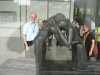
My my dad's cousin was the sculptor Josefina de Vasconcellos. She created a sculpture called "Reconciliation", the original being at Bradford University. She originally created it to represent reunion. Subsequently copies of her sculpture were placed in four cities with war-torn histories: Coventry (1995), Hiroshima (1995), Berlin (1999), and Belfast (2000). Here's the Coventry Cathedral and Hiroshima Peace Conference Centre copies. Personally I like to think she not only captured a sense of reunion and reconciliation, but a strong sense of hope too. Viv.
 
Last edited:
Interesting information and a new insight into Birmingham's role in the weapons programme. The house where Peierls and Frisch lodged is still there. Who'd have thought in this suburban home in the 1940s the work of refugee physicists was being encouraged and nurtured on such ground-breaking research.

Screenshot_20260613_133704_Maps.jpg
 
Last edited:
Pre Japans 2 extra Suns in August 1945
The USS Indianapolis The Inddey was carrying components
for the Bomb
on return journey to US
She was torpedoed by a IJN Sub
900 went into the water
300+ survived
mostly due to sharks
 
Did not realise there was a fadeout. They invited subscribers to pass story on. Have copied last part of article

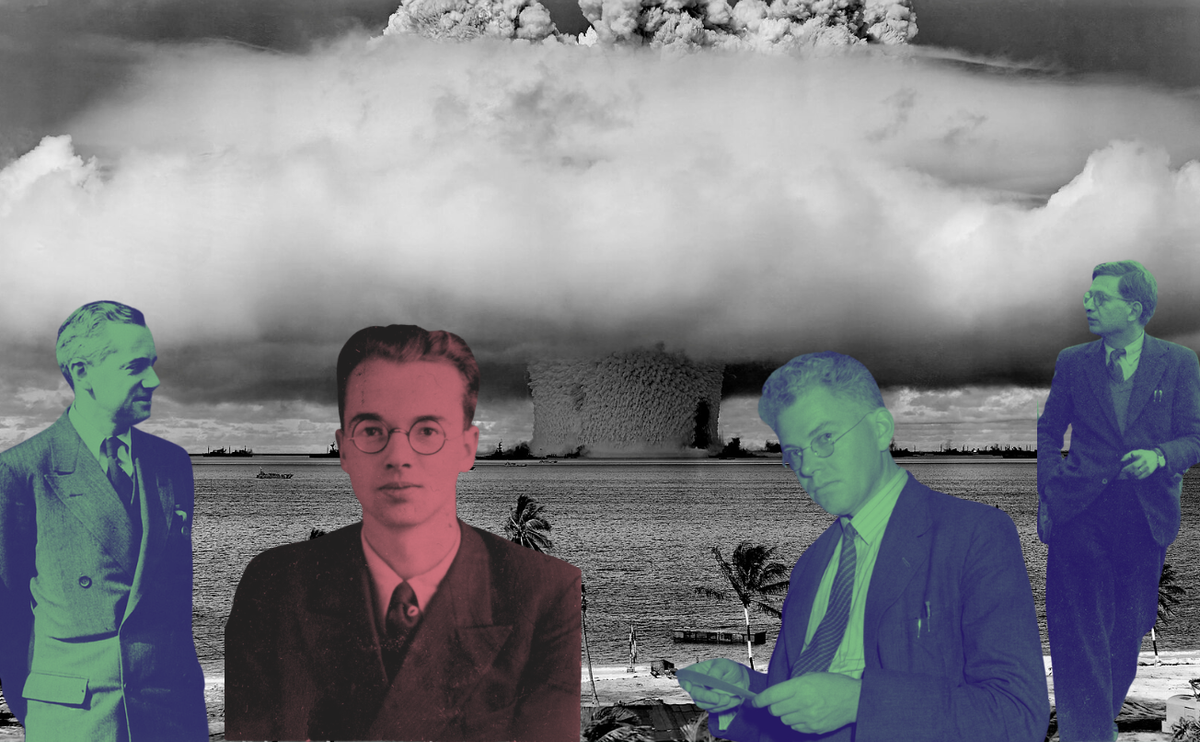
This gave the Peierls the space to take on another lodger at 38 Calthorpe Road. Rudolf’s new partner at the university, Klaus Fuchs, was also a refugee, albeit because of a history of left-wing activity and clashes with the Nazis, rather than being Jewish.

Fuchs had fled to England to continue his studies, but was interned as an enemy alien in the Isle of Man. Eventually released, he moved to Birmingham University in 1941 to work on Tube Alloys.
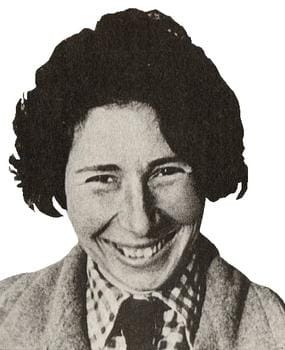
Ursula Kuczynski. Photo: WikiCommons.
Genia Peierls called him “penny-in-the-slot” — a very quiet man who would suddenly become talkative and expansive if asked a question. But she also recalled periods where he would become withdrawn and develop a mysterious cough.

She realised later that these coincided with betrayals. This brilliant physicist responsible for many of the advances in Tube Alloys was also a Soviet spy.

Fuchs would take documents and photos from Edgbaston to his handlers — which included Ursula Kuczynski or ‘Agent Sonya’, “the most influential female spy of all time” — who he would meet in Oxfordshire country lanes.

The Soviet Military Intelligence Director at the time later described Fuchs’ intelligence as hugely important, convincing the Soviets that the British were researching a weapon that would “put humanity on the road to hell”.

The project moves overseas

Meanwhile, Mark Oliphant began to realise that the British, despite being well ahead in technical knowledge, did not have the resources or the spaces safe enough from the Luftwaffe to build a bomb.

He had been pressuring the Americans to take the lead for some time. He was frustrated that his reports had been ignored, and that US science chief Vannevar Bush was sceptical about both the bomb and collaboration with the British.

In 1941, Oliphant travelled from Birmingham to the US under the guise of radar research. In fact he was there to work out why the Americans were so disinterested. He found his reports locked in a safe, unread. Perturbed, he flew to Berkeley to speak directly to his friend Ernest Lawrence, who introduced him to Robert Oppenheimer. His arguments were successful; the Manhattan Project, the US mission to build a nuclear bomb, was born.

In 1943, Winston Churchill and Franklin D. Roosevelt signed the Quebec Agreement, which merged Tube Alloys into the Manhattan Project and handed over the UK’s far more advanced nuclear research. While the deal mandated information sharing, it also gave the Americans a veto over British use of the findings for commercial or industrial use.

Oliphant, Peierls and Fuchs left Birmingham for various sites in the United States. The latter two were present at Trinity, the first atomic bomb test in the New Mexico desert. But when Japan was bombed, they were horrified by the scale of devastation, particularly the attack on Nagasaki. It was unnecessary, they thought, given what had already happened at Hirosh

After the war

It wasn’t until 1950 when Fuchs’ double life was revealed. By then he’d funnelled key documents from the Manhattan Project to the Soviets, including the detailed design of the bombs dropped on Japan. He continued his espionage in the postwar years until he was discovered — while working with Oliphant (who returned to Australia and supervised from afar) and Peirels on the UK’s nuclear programme at Harwell – passing intel to his Soviet spymasters.

Eventually, he was sentenced to 14 years in prison and stripped of his British citizenship. When released in 1959, he emigrated to East Germany.

A year after his arrest, the US Congress stated: “Fuchs alone has influenced the safety of more people and accomplished greater damage than any other spy, not only in the history of the United States, but in the history of nations.” And it all started in a Birmingham houseshare.
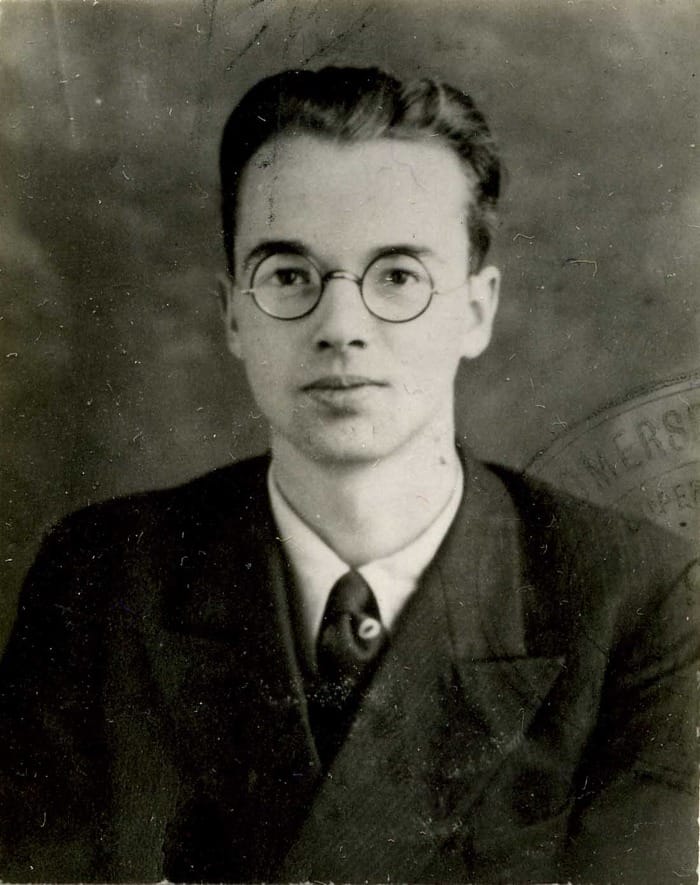
Klaus Fuchs police headshot. Photo: 1951-52 National Archives.
It is still debated today, but it is possible that without Fuchs the USSR would not have been able to conduct its first ever atomic bomb test in 1949. Certainly, it was a great surprise to the CIA.

The revelation was a “shattering blow” for the Peierls, who were unable to understand their friend’s betrayal. Genia had been like a surrogate mother, going as far as buying his clothes, and wrote a tearful letter demanding answers. When Rudolf visited Fuchs in Brixton Prison in 1950, he was astonished by his “arrogance and naivety.”

Peierls himself turned down a Cambridge chair and remained in Birmingham until 1963, when he became Wykeham Professor of Physics at the University of Oxford; he would live out the rest of his years there, accepting a knighthood in 1968.

This went some way to redressing a wrong he had endured postwar, when suspicion fell on him in the wake of Fuchs’ unmasking as a spy. The fallout had seen Peierls forced to leave the British nuclear programme for three years, until he was invited to return.

Later in life he was struck with horror at his own creation. With the threat of Nazism no longer propelling his nuclear work, he became a proponent of arms control, joining the Pugwash disarmament movement. As for Frisch, he also worked at Harwell but spent most of the next 30 years as a professor at Trinity College, Cambridge. Later he would describe the fruits of his work as “a weapon of unparalleled violence, a weapon of mass destruction such as the world had never seen”.

None of this background, or the men themselves — except for Fuchs — appear in Oppenheimer, Christopher Nolan’s celebrated film following the creation of the atomic bomb. But there’s a good argument that the road to the bomb began in Birmingham, in an unassuming Georgian house, on a leafy Edgbaston street.


Comments​

 
38 Calthorpe Road was not only remarkable because of three key figures, Peieris, Frisch and Fuchs associated with the nuclear project, but also for Professor Charles Lapworth who was Professor of Geology at Mason College and later the University of Birmingham from 1881 to 1913. He lived at this address from sometime after 1901 until his death in 1920.

He was one of the most influential geologists of the Victorian and Edwardian period, and is best known for establishing the Ordovician Period as a distinct geological system.
 
Back
Top