
-
Welcome to this forum . We are a worldwide group with a common interest in Birmingham and its history. While here, please follow a few simple rules. We ask that you respect other members, thank those who have helped you and please keep your contributions on-topic with the thread.
We do hope you enjoy your visit. BHF Admin Team
You are using an out of date browser. It may not display this or other websites correctly.
You should upgrade or use an alternative browser.
You should upgrade or use an alternative browser.
Gem Street School
- Thread starter JKC
- Start date

O
O.C.
Guest
Growing up in the slums we were always told if ya don't learn you will end up in Gem Street which I suppose must have been a school for kids with learning disabilities, I use to pass the school once a week for my weekly dose of sun-ray treatment.......which did.......nothing as it was an arc lamp.....now considered dangerous

O
O.C.
Guest
I used to have to go to the clinic in Sheep Street and Gem Street was the next Street .....one end of Gem Street was Aston Street the other end Coleshill Street ......I will post a map in a bit

gingerjon
GONE BUT NOT FORGOTTEN R.I.P.
gem street
https://www.astonbrook-through-astonmanor.co.uk/id95.htm this is the church in Gem street
scroll down to Gem street which was two up from Duke street or off Aston street
https://www.astonbrook-through-astonmanor.co.uk/id95.htm this is the church in Gem street
scroll down to Gem street which was two up from Duke street or off Aston street
O
O.C.
Guest
Old map Gem street in the middle
R
Rod
Guest
Have a butchers
Theres a reference to the school mentioned here.
Theres a reference to the school mentioned here.

Yah We Took The Mickey Outof The Kids
Whom Attended Gem Street
If We Spoke With Other Kids ,and They Did Not Agree To What We Was Telling Them , Or Could Not Under Stand What We Was Telling Them
We Would Say Are You Thick , Or Do You Go To Gem Street School Mate,
Whom Attended Gem Street
If We Spoke With Other Kids ,and They Did Not Agree To What We Was Telling Them , Or Could Not Under Stand What We Was Telling Them
We Would Say Are You Thick , Or Do You Go To Gem Street School Mate,

brummie nick
master brummie
Back in the 1880's it was a sort of remand home, see here.
https://www.missing-ancestors.com/CENSUS FOR gem_street_ind sch 1891 Page 1l.htm
https://www.missing-ancestors.com/CENSUS FOR gem_street_ind sch 1891 Page 1l.htm
D
dollyferret
Guest
when i was in high st ,they used to bring the kids from gem st to burlington hall for dinners sometimes,and us kids would climb up the windows a nd shout and pull faces at them as most of em would have their dinner all over their faces ,they would retaliate by throwing mash potato(it was always that) back all up the windows,what seemed great fun 50years ago takin it out of the feeble minded seems now terribly cruel and thoughtless,but as kids it was all part of playing outdoors(nobody mention frogs and straws or we will all be arrested)


Alf
Gone but not forgotten. R.I.P.
I am sure there was a school named either Gem Street / Gen Street or am I going bonkers....I did try the search on the above, got nothing back, same appiles to friendsreunited......someone please put me out of my misery.
Yes John there was, my Mom & Aunt went there and there was not much wromg with them, by the way I posted this yesterday 1st reply don't know where it WENT


Pomgolian
Kiwi Brummie
:angel: Not dreaming John... Here are three pic's of Gem Street and School 
The caption under Pic' 1 Says:
The caption under Pic' 1 Says:
(The only part I couldn't make out was who supplied the photo, sorry).Lily Place Gem St 1910. One of the many courts of back to back housing which were prevalent in Birmingham during the nineteenth century.
Gem St was situated in the area now occupied by part of the University of Aston.
Birmingham General Library Warks Photo By ?
Last edited:
I know its been some time since this post started but yes definately there was a Gem St School in fact there were 4 schools in all, one was indeed Bishop Ryders, I went there for a couple of years, then there was the school for the deaf and dumb one for the blind and last but not least the infamous Gem St itself! This was a school for children with learning difficulties. Gem st came out almost opposite the back of the Central fire station!
My dad went to Gem Street School around 1920 - by all accounts it was a tough establishment. I think that's where he first took up boxing, probably as a means of self-preservation. He became a pretty useful light-middleweight in his teens, until an accident put paid to his boxing.
I have vague memories of (I think) Sheep Street Clinic where I attended to have my knock-knees rectified!
Big Gee
I have vague memories of (I think) Sheep Street Clinic where I attended to have my knock-knees rectified!
Big Gee

BrummieGeoff
Sparkhill Lad
An early picture of Gem Street Industrial School.
There is an interesting summary of the school's history at ....
In 1846 the rector of St Philip's Church, Birmingham, the Reverend Grantham Munton Yorke, founded a ragged school in rented premises in Lichfield Street. This followed a survey of several streets of the parish, which found that many poor parents were unable or unwilling to make any provision for the education of their children. The school was popular, and the premises in Lichfield Street were unsuitable for long-term use, so, in 1848, the governors of King Edward's School made a grant to the governors of land in Gem Street, on which was built a new school.
The Birmingham Industrial School, Gem Street, opened in 1850 to cater for the children of indigent parents, orphans, and neglected children. Children whose parents were considered to be able to pay the fees for parochial schools were not admitted. The school consisted of three departments: the first was a day school for children above seven years of age; the second was industrial classes for children over seven; and the third was an asylum for deserted and orphan children. The day school taught reading, writing and arithmetic, and gave biblical instruction, although lessons were sometimes varied to include English history, geography, and singing. The industrial school taught skills in subjects such as tailoring, shoemaking, or needlework. Children were provided with meals as wages for their work. The asylum was originally designed to accommodate 15-20 boys and the same number of girls, and orphaned or deserted children could be committed there for a payment of £8 per annum. The number of boarders rose rapidly, and by the mid-1850s expansion of the sleeping quarters was already necessary.
The school was funded largely by subscriptions and donations, along with the board and lodging payments for asylum residents, and the income from the children's labour. In 1858 the school began to take in a large number of children of soldiers killed during the Crimean War, who were paid for by the Patriotic Fund Committee. By 1864, however, income from this source was beginning to decline, and the school began to suffer financial difficulties; this led to the decision of the governors, in 1868, to certify the school under the Industrial Schools Act 1866. This meant that children between the ages of seven and 14 could be placed in the school by magistrates if they were vagrants, if they were under 12 and had committed an offence normally punishable by prison, or were beyond the control of their parents. The maintenance of each child was then paid for by the state, although the school continued to rely on donations and subscriptions for further expenditure.
As time went on the school added different types of work to raise money. One activity which brought in considerable income was selling firewood, where the children chopped wood into sticks and then tied them into bundles to be sold. By the 1870s around 200,000 bundles of firewood were being sold annually. Boys also worked in local factories while still living at the school. They were allowed to keep a proportion of their wages, with the rest being paid to the school. Girls were trained to enter domestic service.
By 1873 there was an increasing view that girls and boys should not be accommodated in the same industrial schools, and this, along with the overcrowded state of the Gem Street premises, prompted the governors to seek separate accommodation for the girls. Accordingly, in December 1873, the girls were removed to a board school at Sparkhill, and from then on the Birmingham Industrial School took only boys. The school by this time was licensed to accommodate 152 children.
In the 1890s further subjects were added to the school curriculum, including geography, technical drawing and woodwork, and the governors had purchased a site in Harborne which was used largely for recreation. By this time the yearly inspection reports had become critical of the Gem Street site, describing it as "dingy and institutional" and blaming the poor accommodation for regular outbreaks of sickness. The inspectors urged the governors to relocate the school to the Harborne site and so, in 1901, work began on a new school building. In December 1902 the school relocated to Harborne and became known as the Birmingham Industrial School (Harborne), or sometimes Harborne Industrial School. The premises in Gem Street were sold to the Birmingham School Board. The new school initially covered seven acres, including two and a half acres of garden and a large playing field, and over the next several years adjoining plots of land were bought.
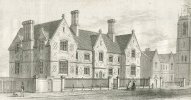
There is an interesting summary of the school's history at ....
In 1846 the rector of St Philip's Church, Birmingham, the Reverend Grantham Munton Yorke, founded a ragged school in rented premises in Lichfield Street. This followed a survey of several streets of the parish, which found that many poor parents were unable or unwilling to make any provision for the education of their children. The school was popular, and the premises in Lichfield Street were unsuitable for long-term use, so, in 1848, the governors of King Edward's School made a grant to the governors of land in Gem Street, on which was built a new school.
The Birmingham Industrial School, Gem Street, opened in 1850 to cater for the children of indigent parents, orphans, and neglected children. Children whose parents were considered to be able to pay the fees for parochial schools were not admitted. The school consisted of three departments: the first was a day school for children above seven years of age; the second was industrial classes for children over seven; and the third was an asylum for deserted and orphan children. The day school taught reading, writing and arithmetic, and gave biblical instruction, although lessons were sometimes varied to include English history, geography, and singing. The industrial school taught skills in subjects such as tailoring, shoemaking, or needlework. Children were provided with meals as wages for their work. The asylum was originally designed to accommodate 15-20 boys and the same number of girls, and orphaned or deserted children could be committed there for a payment of £8 per annum. The number of boarders rose rapidly, and by the mid-1850s expansion of the sleeping quarters was already necessary.
The school was funded largely by subscriptions and donations, along with the board and lodging payments for asylum residents, and the income from the children's labour. In 1858 the school began to take in a large number of children of soldiers killed during the Crimean War, who were paid for by the Patriotic Fund Committee. By 1864, however, income from this source was beginning to decline, and the school began to suffer financial difficulties; this led to the decision of the governors, in 1868, to certify the school under the Industrial Schools Act 1866. This meant that children between the ages of seven and 14 could be placed in the school by magistrates if they were vagrants, if they were under 12 and had committed an offence normally punishable by prison, or were beyond the control of their parents. The maintenance of each child was then paid for by the state, although the school continued to rely on donations and subscriptions for further expenditure.
As time went on the school added different types of work to raise money. One activity which brought in considerable income was selling firewood, where the children chopped wood into sticks and then tied them into bundles to be sold. By the 1870s around 200,000 bundles of firewood were being sold annually. Boys also worked in local factories while still living at the school. They were allowed to keep a proportion of their wages, with the rest being paid to the school. Girls were trained to enter domestic service.
By 1873 there was an increasing view that girls and boys should not be accommodated in the same industrial schools, and this, along with the overcrowded state of the Gem Street premises, prompted the governors to seek separate accommodation for the girls. Accordingly, in December 1873, the girls were removed to a board school at Sparkhill, and from then on the Birmingham Industrial School took only boys. The school by this time was licensed to accommodate 152 children.
In the 1890s further subjects were added to the school curriculum, including geography, technical drawing and woodwork, and the governors had purchased a site in Harborne which was used largely for recreation. By this time the yearly inspection reports had become critical of the Gem Street site, describing it as "dingy and institutional" and blaming the poor accommodation for regular outbreaks of sickness. The inspectors urged the governors to relocate the school to the Harborne site and so, in 1901, work began on a new school building. In December 1902 the school relocated to Harborne and became known as the Birmingham Industrial School (Harborne), or sometimes Harborne Industrial School. The premises in Gem Street were sold to the Birmingham School Board. The new school initially covered seven acres, including two and a half acres of garden and a large playing field, and over the next several years adjoining plots of land were bought.