• Welcome to this forum . We are a worldwide group with a common interest in Birmingham and its history. While here, please follow a few simple rules. We ask that you respect other members, thank those who have helped you and please keep your contributions on-topic with the thread.

    We do hope you enjoy your visit. BHF Admin Team

High Street Deritend Digbeth

A few more newspaper references, taking back Crowleys Court to at least the 1820s, one address specifies 'High Street' :

13/3/1824 Mr Lockman of Crowleys Court, Deritend (Baldwins London Weekly Journal)
18/9/1848 Henry Adderley, Crowleys Court Deritend accused of stealing poultry (Birmingham Journal)
12/4/1851 Thomas Hadley, Crowleys Court, High Street Deritend accused of pick pocketing (Birmingham Journal)
 
found jane on the 61 census...father was a military ornament maker..address says no 3 crowleys court high st deritend..cant seem to find a death or burial record for her at the min but father john aged 28 is a widow so he lost both daughter and wife close together...very sad..also his marr cert says he was married in 1856

lyn
 
Last edited:
in 1871 john wright is living alone at court 1 house 3 high st deritend which i presume is the same address as crowleys court house 3 which is i think what mike said

lyn
 
if we look at mikes map on post 208 he has marked out court no 1 in red but on looking again if you look closely down the left it also says court no 1 so it must have gone back further and i have a feeling that the big house was somewhere there...i just cant see it fronting the main high street..again its all guess work..

lyn
 
Just in case it's of interest, a Mr Crowley of Cheapside (1843) served on the Town Council General Purposes Committee. There was also a Crowley's Wharf, at The Cresent in 1867.
 
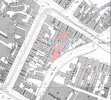
Yes. Lyn was correct. Unfortunately the NLS site does not now provide complete joined up scans of the 1880s maps, probably because in some cases the separate sheets do not completely join up. .The court concerned is at the junction of three sheets!. However I have an older accessed map , shown below, on which I have narked all court 1 in red. It can be seen that there are several possibilities on the "lower" part of the court tom be these houses.
Thanks Lyn1880s court 1 deriend high st.jpg
 
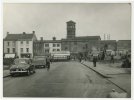
It was originally built as a chapel in 1913 for St Edmund’s Boys Home. It's Grade II listed. It was run as St. Edmunds Boys Home by Father John Lopes until the 1960s, subsequently the premises have been used for a number of commercial purposes. See post #81 of this thread.
 
Bridge row is not shown on th wOS c1917-27 or the 1937 map. It is listed at the beginning of Kellys as a thoroughfair (at 13 Deritend) , but not individually , nor as an opening at no 13, though it does list "Stoneyard as an opening about there.

map_deritend_c1937.jpg


map_deritend_c1917-27.jpg
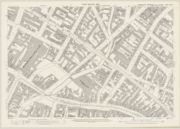
Hello, I am interested in Stone Yard, Deritend shown in the centre of this map (it still exists on Google Maps today). From about 1854 to 1871 Felix Joseph Siviter (b1833 Halesowen) lived at 33 Stoneyard, Deritend and can easily be found on the 1861 and 1871 censuses. Joseph was a bricklayer which I initially thought fits in nicely with Stoneyard. But by browsing the neighbouring households it is clear that a) that Stoneyard was substantial and the inhabitants were from all trades. It was not just a builder's compound. Can anybody tell me anything of the history of Stoneyard and what it might have been like in the 1860s to 1870s. Also anything about Felix Joseph Siviter himself would be icing on the cake.
 
Hello, I am interested in Stone Yard, Deritend shown in the centre of this map (it still exists on Google Maps today). From about 1854 to 1871 Felix Joseph Siviter (b1833 Halesowen) lived at 33 Stoneyard, Deritend and can easily be found on the 1861 and 1871 censuses. Joseph was a bricklayer which I initially thought fits in nicely with Stoneyard. But by browsing the neighbouring households it is clear that a) that Stoneyard was substantial and the inhabitants were from all trades. It was not just a builder's compound. Can anybody tell me anything of the history of Stoneyard and what it might have been like in the 1860s to 1870s. Also anything about Felix Joseph Siviter himself would be icing on the cake.
joseph siviter (no felix so maybe he didnt like the name) appears in british newspaper archives a few times by the looks of it...a 1907 snippet tells of him bringing a case against aston workhouse at that time he lived at 41 coleman st and was a bricklayer so i assume its the same person

lyn
 
In 1874 Joseph Felix Siviter appears to have been bankrupt with debts of £300. Described as Coal Dealer and Builder of the Stone Yard, Deritend.

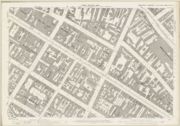
Also it looks like Stone Yard was just the name of a street at this time, maybe taking it's name from an actual stone yard that may have been there previously. Better maps below - part of it at the bottom of the first and the other part at the top of the second...


Last edited:
Hello, I am interested in Stone Yard, Deritend shown in the centre of this map (it still exists on Google Maps today). From about 1854 to 1871 Felix Joseph Siviter (b1833 Halesowen) lived at 33 Stoneyard, Deritend and can easily be found on the 1861 and 1871 censuses. Joseph was a bricklayer which I initially thought fits in nicely with Stoneyard. But by browsing the neighbouring households it is clear that a) that Stoneyard was substantial and the inhabitants were from all trades. It was not just a builder's compound. Can anybody tell me anything of the history of Stoneyard and what it might have been like in the 1860s to 1870s. Also anything about Felix Joseph Siviter himself would be icing on the cake.

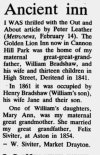
Any relation ? Birmingham News March 1992.


IMG_2405.jpeg
 
November 1874, Joseph Felix Siviter files for liquidation. £300 liabilities and £50 assets.

Described as coal dealer and builder.
 
Back
Top