
-
Welcome to this forum . We are a worldwide group with a common interest in Birmingham and its history. While here, please follow a few simple rules. We ask that you respect other members, thank those who have helped you and please keep your contributions on-topic with the thread.
We do hope you enjoy your visit. BHF Admin Team
You are using an out of date browser. It may not display this or other websites correctly.
You should upgrade or use an alternative browser.
You should upgrade or use an alternative browser.
Lancaster and Son photographic equipment
- Thread starter Heartland
- Start date

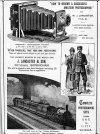
J. Lancaster and Son, optician and camera maker, of Irving Street, Birmingham.
Made wooden view cameras, among them several cameras for smaller plate formats.
Made wooden view cameras, among them several cameras for smaller plate formats.
- The 1/4-plate Instantograph was one of the better known.
- A very special model was the Gem Apparatus of 1880, a camera with twelve lenses to shoot the same subject twelve times at once.

They seem to have had quite a long history.
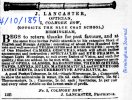
Source: British Newspaper Archive
Source: British Newspaper Archive

From a link in another thread. A list of Lancaster cameras , and the information that the company was founded in 1835 and ceased trading in 1955.
https://collectiblend.com/Cameras/Lancaster/
https://collectiblend.com/Cameras/Lancaster/
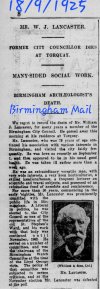
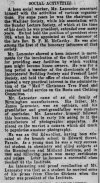
toolate4regrets
knowlegable brummie
By 1900 Lancaster were the largest camera comany in the world, and the owner, William James lancaster is regarded as being the man who made amateur photography possible. The earliest record I have of them making cameras was from around 1854. Also if you fancy owning a Lancaster watch camera that @Stokkie mentioned, there is currently one on ebay at £41,470 (to be honest thats a fair price)
I think that Eastman Kodak might have had something to do with the development of amateur photography. "You Press the Button, We Do the Rest" The Kodak system enabled rolls to be sent away for development or handed to the chemist. Originally the entire camera was returned.
With a plate camera you have to develop the plate in the dark. Fantastic quality though, because of a big negative and easy to retouch.
With a plate camera you have to develop the plate in the dark. Fantastic quality though, because of a big negative and easy to retouch.
toolate4regrets
knowlegable brummie
Before Lancaster, photography was still expensive and compicated, Lancaster put photography in the hands of 100s of 1000s of people before Kodak came over to the UK... also Kodak took the invention of Alexander Parkes in Birmingham and had better marketing than Pumphrey brothers of Birmingham, which helped Kodak become successfulI think that Eastman Kodak might have had something to do with the development of amateur photography. "You Press the Button, We Do the Rest" The Kodak system enabled rolls to be sent away for development or handed to the chemist. Originally the entire camera was returned.
With a plate camera you have to develop the plate in the dark. Fantastic quality though, because of a big negative and easy to retouch.
The history of photography isn't a development from one person or company, but a synthesis of many knowledges and inventions. I think more of us will have owned a Box Brownie than will have a Lancaster. I've developed 4x5 sheet film in trays in my bathroom and the process demands absolute darkness, expensive film and chemicals. I was happy to use a commercial dark room. I know Lancaster used dry plates, but did they ever use roll film backs?Before Lancaster, photography was still expensive and compicated, Lancaster put photography in the hands of 100s of 1000s of people before Kodak came over to the UK... also Kodak took the invention of Alexander Parkes in Birmingham and had better marketing than Pumphrey brothers of Birmingham, which helped Kodak become successful
From The British Journal Photographic almanac :The history of photography isn't a development from one person or company, but a synthesis of many knowledges and inventions. I think more of us will have owned a Box Brownie than will have a Lancaster. I've developed 4x5 sheet film in trays in my bathroom and the process demands absolute darkness, expensive film and chemicals. I was happy to use a commercial dark room. I know Lancaster used dry plates, but did they ever use roll film backs?
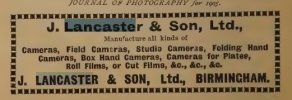
So it appears that they did
Thanks Mike. Appreciated.
umptibuzzle
New Member
I hoped that Birmingham History would be able to give me some information about J Lancaster and Son. They were major manufacturers and suppliers of photographic equipment and were well known for the Instantograph cameras. The information that I have so far indicates that these models were introduced from about 1892, but an advertisement in the Amateur Photographer in 1884 refers to this model, so clearly it was available in some form earlier.
I understand that by about 1900 Lancaster were possibly the largest supplier of photographic equipment.
Someone must know something or where to find the something.
Any advice will be much appreciated.
Thank you.
I understand that by about 1900 Lancaster were possibly the largest supplier of photographic equipment.
Someone must know something or where to find the something.
Any advice will be much appreciated.
Thank you.

I've made the thread title a little more specific and moved the thread to a different section.


.On the camera thread, (https://birminghamhistory.co.uk/forum/threads/birmingham-camera-companies.47919/#post-595730) Viv listed this link, possibly of interest
:https://collectiblend.com/Cameras/Lancaster/
:https://collectiblend.com/Cameras/Lancaster/
James Lancaster is listed as a steel spectacle maker at 93 Cecil Street in Pigots 1841 directory. By 1845 he is at 67 Hanley Street and 25 Summer Lane, though that seems merely to be on a corner , so has two addresses. In 1850 he is at 7 Summer Lane plying his trade, but by 1855 he is at 5 Colmore Row. In 1867 there is a James Lancaster , manufacturing optician at 5 Colmore Row, but also a James Lancaster (perhaps his son) , steel spectacle maker, at court 1 Sherlock Street. All these, and in 1861 and 1862, just refer to opticians. However Dix's 1858 directory lists:
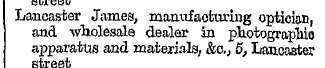
While the 1872 and 1873 directoies list:
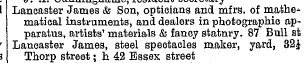
While the 1872 and 1873 directoies list:
And another thread here:
https://birminghamhistory.co.uk/forum/threads/lancaster-makers-of-cameras.58468/
https://birminghamhistory.co.uk/forum/threads/lancaster-makers-of-cameras.58468/
Mark Tooze
master brummie
A few adverts from Getty Images library:-
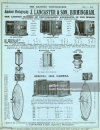
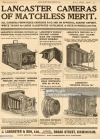
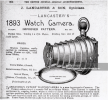

pjmburns
master brummie
Some info about them here
also here
also here
Mark Tooze
master brummie
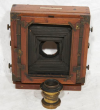
Instanagraph Camera J Lancaster 1889
Mark Tooze
master brummie
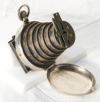
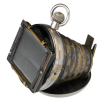
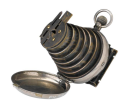
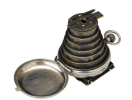
Lancaster Watch Camera 1892
The Lancaster Watch Camera is very collectable and can fetch ridiculous sums at auction. 18K - 30K euro. condition is everything. CameraWorth.View attachment 224111
View attachment 224113
View attachment 224115
View attachment 224117
Lancaster Watch Camera 1892
More on the Lancaster Watch Camera here. Rare Historical Photos
Someone has a men's version on EBay for £42K!!
The petite lady's version is really scarce.
Ebay has lots of examples of Instantograph folding cameras for a couple of hundred pounds. They would probably need new light-tight bellows and a clean lens plus a back to take modern film dark slides if anyone wanted to take pictures with them.
Someone has a men's version on EBay for £42K!!
The petite lady's version is really scarce.
Ebay has lots of examples of Instantograph folding cameras for a couple of hundred pounds. They would probably need new light-tight bellows and a clean lens plus a back to take modern film dark slides if anyone wanted to take pictures with them.
Mark Tooze
master brummie
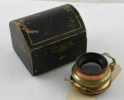
Lens and Box J Lancaster and Son
Mark Tooze
master brummie
Some of these cameras and lenses are works of art on their own - I bet you could get amazing pictures with them.
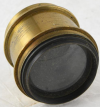
Lens J Lancaster and Son
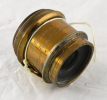
Achromatic Landscape Lens J Lancaster and Son 1885
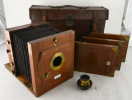
International Folding Bellows Stand Camera J Lancaster and Son 1888
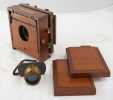
Instantograph Camera J Lancaster and Son 1885
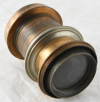
Rectigraph Symmetrical Lens J Lancaster and Son 1885
Lens J Lancaster and Son
Achromatic Landscape Lens J Lancaster and Son 1885
International Folding Bellows Stand Camera J Lancaster and Son 1888
Instantograph Camera J Lancaster and Son 1885
Rectigraph Symmetrical Lens J Lancaster and Son 1885
Mark Tooze
master brummie
All these items are from the Science Museum national collection by the way. It would be fascinating to try a few of these out - they did a similar exercise with the camera Harry Burton used when he did the official photographs of Tutankhamuns tomb in the 1920s.
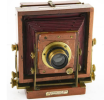
Special Instantograph Bellows Camera J Lancaster and Son 1898
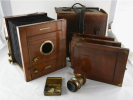
Instantograph Bellows Camera Case and Slides J Lancaster and Son 1887
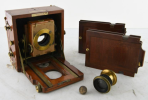
Instantograph Camera and Slides J Lancaster and Son 1894
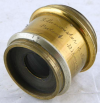
Instantaneous Landscape Lens J Lancaster and Son 1885
Special Instantograph Bellows Camera J Lancaster and Son 1898
Instantograph Bellows Camera Case and Slides J Lancaster and Son 1887
Instantograph Camera and Slides J Lancaster and Son 1894
Instantaneous Landscape Lens J Lancaster and Son 1885
Mark Tooze
master brummie
And Lancasters made other things apart from photographic equipment:-
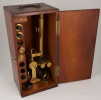
Binocular Microscope J Lancaster and Son 1850s
Binocular Microscope J Lancaster and Son 1850s