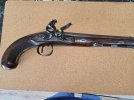
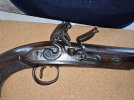
As it's Burn's a Night tonight here's a Birmingham connection with the great poet. Viv.
View attachment 95916
Last edited:

As it's Burn's a Night tonight here's a Birmingham connection with the great poet. Viv.
View attachment 95916
My information about all this is that David Blair gave Burns the flintlock holster pistols and Burns famously acknowledged their receipt and sent Blair new verses of his poetry. The double barrelled pistols have Blair's marks imprinted. The excise pistols are quite different and may well have "come with the job". The two are compared below:Hi Wam. Very intriguing. Also I think there are differences in whether Dr Maxwell was given Burns's duelling pistols or his excise pistols. Viv.
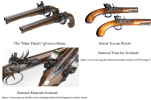
Good morningThere's an account of David Blair, his gun making and his other activities in Birmingham Archives and Collections (Local History).
Edited to update detail to version 2.1 August 2026
Sorry pjm, you must have replied to my comment #37 whilst I was editing it and removing the bit where I said I couldn't read the word before Anderson on the inscription. Because, belatedly, I had also realised what you had rightly said earlier!The word before Anderson is simply the Latinised spelling of John.
Thank you for your reply. I live in New Zealand (as do the pistols) and the firearms have been in this country for several decades. I will consult my friend next time I see them to glean some more information about their ancestor. There are gold and silver furnishings as well as silver marks clearly visible on the underside of the stock. These pistols are in excellent condition, as are the accessories. I was told that they have never been fired but I cannot verify that. They certainly look pristine. The barrels (smoothbore, of course) are 56cal, bright and unmarked. I will post when I get some more detail about the Anderson family.How interesting - thank you!
As you say, these are good quality flintlock pistols by David Blair & Co of Birmingham but they do not seem to have quite the same features as the Blair & Sutherlands pair (see HERE) which I thought were unusually fine although I'm no firearms expert. On the inscription, armigerum means "Esquire" as pjmburns says above. In older times "Esquire" could be taken to denote a member of the gentry who had the right to bear a heraldic coat of arms but that may not apply here because it is later.
So I would translate the inscription as "A mark of gratitude to John Anderson Esquire". I think this type of inscription is fairly characteristic of antique flintlock presentation or duelling pistols from the late 18th or early 19th century. This type of pistol would have been commissioned as a prestigious gift or token of respect - typically between members of the gentry although sometimes by appreciative colleagues in the military (but in that case the recipient's rank would usually be stated) and occasionally as an outright special gift of respect in much the same way as David Blair made his to Robert Burns. So a task now is to find an upstanding Anderson perhaps, although by no means necessarily, from our neck of the woods to whom this might refer! Can you help us with any other clues about the original Anderson who received the pistols?
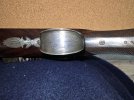
To narrow things down as far as the gun is concerned could you share a clearer image of the middle circular mark in your photo 3 and say if there are any other stamps (like crown or arrow marks) on the steel barrel? The engraved pineapple shape is a specific ornamental design known as a pineapple finial. It is part of the metal extension projecting forward from the trigger guard into the wooden stock. It's seen around this time on more bespoke firearms.
Thank you - might the original Anderson have been Scottish? From your description it sounds as if this pair of pistols might be rather valuable! I wonder if it might be a plan to get them assessed and valued at a good auctioneers with a specialist antique firearms department in New Zealand? It's still worth pursuing the details of the original owner because this would establish a clearer provenance. (An internet search suggests top antique firearms specialists in New Zealand include Carvell's Auctions and specialised dealers like Harrison Rifle Company if that's any help.)Thank you for your reply. I live in New Zealand (as do the pistols) and the firearms have been in this country for several decades. I will consult my friend next time I see them to glean some more information about their ancestor. There are gold and silver furnishings as well as silver marks clearly visible on the underside of the stock. These pistols are in excellent condition, as are the accessories. I was told that they have never been fired but I cannot verify that. They certainly look pristine. The barrels (smoothbore, of course) are 56cal, bright and unmarked. I will post when I get some more detail about the Anderson family.