• Welcome to this forum . We are a worldwide group with a common interest in Birmingham and its history. While here, please follow a few simple rules. We ask that you respect other members, thank those who have helped you and please keep your contributions on-topic with the thread.

    We do hope you enjoy your visit. BHF Admin Team

Thomas Dobbs

Neil M

master brummie
Thomas Dobbs was an 18th century Kings Norton water mill owner who had a contract with Boulton & Watt to convert to steam power and lived at Lifford Hall but he was also said to be a comedian, apparently "of infinite jest and of most excellent fancy". What does anyone know of this Kings Norton character?
 
Last edited:
Thomas Dobbs was an 18th century Kings Norton water mill owner who had a contract with Boulton & Watt to convert to steam power and lived at Lifford Hall but he was also a well known comedian, apparently "of infinite jest and of most excellent fancy". What does anyone know of this intriguing Kings Norton character?
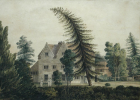
1786038070475.png
From an auction catalogue:

A View of Lifford Hall, Kings Norton, Worcestershire, the Residence of Mr Dobbs, with a spectacular Captain Cook's Pine in the foreground​

Other notes: Thomas Dobbs bought Lifford Hall in 1789; he was an engineer who constructed both the Birmingham to Worcester and the Birmingham to Stratford-upon-Avon Canals. Thomas Dobbs and his wife had three daughters; Mrs Dobbs and the three girls are depicted in the present watercolour.

Albion Metal:
It was introduced and patented in 1804, by Thomas Dobbs, an inventor from Kings Norton who was also a comic actor at the Theatre Royal in Birmingham, England.[Wikipaedia]
 
Don't know if any of these are of interest
 

Attachments

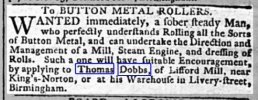
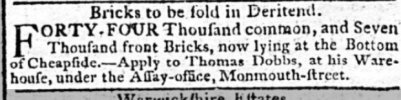
  • Aris birm Gaz 25.7.1791.jpg
    Aris birm Gaz 25.7.1791.jpg
    44.3 KB · Views: 5
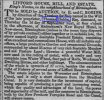
  • Aris Birm Gaz.2.3.1789.jpg
    Aris Birm Gaz.2.3.1789.jpg
    30.3 KB · Views: 4
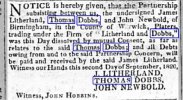
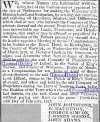
  • Aris birm Gaz,18.9.1820.jpg
    Aris birm Gaz,18.9.1820.jpg
    47.1 KB · Views: 6
  • Aris birm Gaz,15.2.1813.jpg
    Aris birm Gaz,15.2.1813.jpg
    154.9 KB · Views: 6
  • Aris Birm Gaz,24,8,1835.jpg
    Aris Birm Gaz,24,8,1835.jpg
    103.8 KB · Views: 6
Will the real Mr. Dobbs, comedian, please stand up !

Methinks Wikipedia has Thomas and James (not related) mixed up together !

 
Will the real Mr. Dobbs, comedian, please stand up !

Methinks Wikipedia has Thomas and James (not related) mixed up together !

You may well be right. Doesn't seem likely that a successful entrepreneur was also a music hall entertainer! but then Wiki should always be taken with a pinch of salt!
 
You may well be right. Doesn't seem likely that a successful entrepreneur was also a music hall entertainer! but then Wiki should always be taken with a pinch of salt!
Yes I agree that Pedrocut is right about this - the mistake gets promulgated by AI search engines e.g. according to Google's Gemini: "The 1814 reaping machine benefit performance at the Theatre Royal on New Street is one of the most eccentric chapters in Birmingham’s theatrical and industrial history. The event perfectly captured the dual identity of Thomas Dobbs (referred to in some theatrical archives as J. Dobbs), who worked simultaneously as a successful comic actor and a pioneering industrial inventor."

It's a bit alarming just how confidently this is spun into an apparent truth when it is quite wrong. In fact the main reference gets it right and doesn't mention Thomas at all:
"in 1814 J. Dobbs, an actor at the Theatre Royal who had invented a reaping machine, demonstrated it in character, in a play, on an artificial field of wheat on the stage." See https://www.british-history.ac.uk/vch/warks/vol7/pp209-222

So an eye opener in terms of validating searches these days but also disappointing that the hillarious mill owner turns out not to have been funny at all!
 
To me it is just common sense to take NO notice to what AI says, though if they give any references then definitely take the opportunity to search them
 
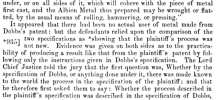
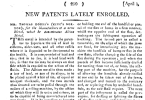
Transcript of the report mentioned above of Dobbs' Albion patent:
April 1805 p250 of "The Monthly Magazine or British Register"

"NEW PATENTS LATELY ENROLLED

MR. THOMAS DOBBS'S (KING'S NORTON), for the Manufacture of a new Metal, which he denominates Albion Metal.

THIS metal is intended by the patentee to supersede the use of lead in cisterns, cider-vats, and all other vessels where it is supposed to be detrimental to the health. It is compounded of lead and tin; that is to say, it is lead lined with tin, so that the tin may be always on that side which is exposed to the action of the fluids. The Albion metal is thus made: a bar of lead, or any of its alloys, is to be placed against a bar of tin, of equal or unequal thickness, and the two metals thus situated are to be passed through the rollers of a rolling machine, by the action of which they will so unite and cohere, as to be capable of being manufactured into any forms. If it be necessary to line the lead on both sides, then the plate or bar of lead is to be placed between two plates or bars of tin, and then passed through the rolling press. Mr. Dobbs recommends as useful, if not necessary, that both the lead and the iron rollers should be made pretty hot before the operation is performed."

There is also detailed information about his time at Lifford Mill from the late 1760s in Demidowicz G, Price S: Kings Norton - A History; Phillmore &Co Ltd, 2009 pp 98-100/105/138-9. He converted the mill from grinding grain to rolling metal. There are details of his use of a roatary steam engine from Boulton & Watt to enable the main wheel of his water mill to function at low water levels, his later development on the site of the "Aqua Fortis Works" making nitric and sulphuric acids and his sale of land at a high price to the Worcester and Stratford Canal Company as well as the construction of Lifford Mill reservoir (needed to maintain his water supply when the canal was built).

 
Back
Top