• Welcome to this forum . We are a worldwide group with a common interest in Birmingham and its history. While here, please follow a few simple rules. We ask that you respect other members, thank those who have helped you and please keep your contributions on-topic with the thread.

    We do hope you enjoy your visit. BHF Admin Team

Lady Huntingdons Chapel, Peck Lane and King Street

Heartland

master brummie
As religious establishments, in Birmingham go, does the Non Conformist Lady Huntingdons Chapel hold a record for a short tenure. It was built in the 1840's and demolished in 1850 to make way for the new Queens Drive and New Street Station, also called Grand Central. Whilst the congregation moved elsewhere during its short existence the newspapers record some marriages there and presumably there were baptisms also,

Peck Lane that connected New Street with Dudley Street was obliterated by the station excavations.
 
gosh heartland that was a short tenure indeed...have to say i have not heard of this chapel and obviously no chance of any photos although i guess it could be marked out on a very old map

lyn
 
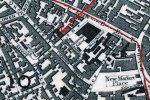
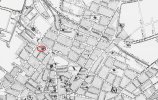
The map supposedly 1839 below seems to show a building in Peck Lane marked in darker hue (as were many churches and other public buildings) but unlabelled. It could be a smudge mark on the map or possibly a later addition. Could this be the chapel?

map c1839 showing Peck Lane with unlabelled building.jpg
 
Last edited:
Looks to have existed in King’s Street in 1838, new building in Peck Street in 1843, and demolished in 1850.
There is a mention of Gooch Street (1857) so with the compensation provided by LNWR that may have relocated.
 
Last edited:
Yes the chapel moved from King Street to Peck Lane and then had temporary accommodation Odd Fellows Hall until the new place was found in 1851. They had at first asked the LNWR for compensation amounting to £12,000 which was reduced by jury to less than half that amount, but I suppose even that amount helped with making the replacement chapel
 
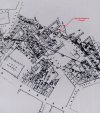
This 1845 map confirms the location of Lady Huntington's Chapel (Building 148) on the corner of Peck Lane and Dudley Street.
The map was submitted by the Birmingham & London Railway as part of its proposals for the new station.
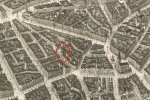
I think the chapel is also represented on "Ackermann's Panoramic View of Birmingham" dated 1847 .... although I'm not sure how accurate the building details are.
Credit: Richard Foster's excellent book - "Birmingham New Street - The Story of a Great Station"

1845 Peck Lane Lady Huntington's Chapel.jpg

1847 Birmingham Ackermann's Panoramic (Lady Huntington's Chapel).jpg
 
The map supposedly 1839 below seems to show a building in Peck Lane marked in darker hue (as were many churches and other public buildings) but unlabelled. It could be a smudge mark on the map or possibly a later addition. Could this be the chapel?

View attachment 174755
In the 1845 London & Birmingham Railway plans, the building indicated by Mike is listed as a chapel in King Street .... so maybe that was the previous site of Lady Huntington's Chapel (ex-theatre), before it moved to Peck Lane?
 
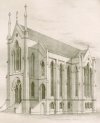
I believe this may be a drawing of Lady Huntingdon's Chapel on the corner of Peck Lane and Dudley Street.
It comes from Birmingham Library with the following description: "Lady Huntingdon’s Chapel on Paradise Street which opened in 1843. The congregation worshipped initially in King Street between 1783 – 1842".
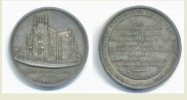
We know that the congregation moved from King Street to a new chapel in Peck Lane in 1843 .... and the drawing resembles the building in the medal in Post #7.
It's possible that this is an architect's drawing of a building planned for Paradise Street, that was actually built in Peck Lane .... or maybe the Paradise Street reference is wrong??

Peck Lane (Dudley Street junction) Lady Huntingdon's Chapel (artwork) built 1843.jpeg
 
Birmingham History Online suggests: Under the heading Lady Huntingdon's Connexion


Paradise Street chapel is said to have been the first chapel of Lady Huntingdon's Connexion in Birmingham, and was opened shortly after 1774. It seems likely that it became a Congregational chapel after the opening of King Street in 1786.

That date is much earlier than the date with the drawing.
 
#14 drawing bears many similarities to Ackerman's Panoramic 1843 representation (circled by BrummieGeoff on the Panoramic view and, as he, suggested bears a resemblance to the medal in post #7). It was described as "elegant and spacious". It certainly looks like that. Think all thise points confirm the drawing is of the Peck Lane chapel.

The King Street chapel operated from 1786 until 1842. It's possible there was an earlier chapel of Lady H on Paradise Street, but if it was built, I doubt it was built in such a grand style as that of post #14, particularly in terms of potential congregation numbers and cost.

Are there any images of chapels c1770s in Paradise Street ?
 
Last edited:
There's a meeting hall mentioned on Wikipedia: "(Paradise) Street existed in 1796 when a congregation gathered at a meeting hall for a sermon"

Could this be the early LadyH Connexion chapel ?
 
Back
Top