
-
Welcome to this forum . We are a worldwide group with a common interest in Birmingham and its history. While here, please follow a few simple rules. We ask that you respect other members, thank those who have helped you and please keep your contributions on-topic with the thread.
We do hope you enjoy your visit. BHF Admin Team
You are using an out of date browser. It may not display this or other websites correctly.
You should upgrade or use an alternative browser.
You should upgrade or use an alternative browser.
Humorous And Interesting Newspaper Stories about Birmingham
- Thread starter Pedrocut
- Start date


Radiorails
master brummie
.........and is said that heat waves are a modern phenomena!

Pedrocut
Master Barmmie
July 1894, The Engineer…
“Much satisfaction was expressed on 'Change in Birmingham on Thursday at the information of the passing of the American Tariff Bill. Reports from the other side of the Atlantic have for so long a time been of a contradictory nature regarding the chances of the measure, that the intelligence of its success in the Senate comes as a relief, and improved anticipations are indulged of the future of trade. Private advices received by certain leading houses in this district announce that when trade revival commences in Americe, and costs of material and manufacture begin to go up there, British iron and steel makers will, under the new duties, now be able to send in material and command American orders. The new tariff entirely removes the duty on baling hoops, of which 40,000 tons are annually consumed for the American cotton crop The probability is that British ironmasters will now secure more of this business than ever before.”
“Much satisfaction was expressed on 'Change in Birmingham on Thursday at the information of the passing of the American Tariff Bill. Reports from the other side of the Atlantic have for so long a time been of a contradictory nature regarding the chances of the measure, that the intelligence of its success in the Senate comes as a relief, and improved anticipations are indulged of the future of trade. Private advices received by certain leading houses in this district announce that when trade revival commences in Americe, and costs of material and manufacture begin to go up there, British iron and steel makers will, under the new duties, now be able to send in material and command American orders. The new tariff entirely removes the duty on baling hoops, of which 40,000 tons are annually consumed for the American cotton crop The probability is that British ironmasters will now secure more of this business than ever before.”
Pedrocut
Master Barmmie
April 1900 in Hill Street…
“On Monday afternoon, the 9th inst., there slowly emerged from the mouth of an underground pipe in Hill-street, Birmingham the last length of the new underground telegraph cable-about 120 miles in length-from London to Birmingham,
The jointing of the lengths drawn in during the last few weeks will take some days, and the date of the inaugural opening ceremony of the new service has yet to be fixed. The work was begun in March, 1897, and has therefore taken a little over three years. The cable consists of seventy-six copper wires, the insulating material used being paper. Grants for the cable to the amount of £150,000 have been made by the Treasury. A lead casing of 2.5 in. diameter is employed, and the cable is drawn into 3in. iron piping, laid about 2.5ft. below the surface of the ground. At intervals of five miles the wires are brought to the surface and passed through examining chambers.”
(The Engineer, April 1900)
“On Monday afternoon, the 9th inst., there slowly emerged from the mouth of an underground pipe in Hill-street, Birmingham the last length of the new underground telegraph cable-about 120 miles in length-from London to Birmingham,
The jointing of the lengths drawn in during the last few weeks will take some days, and the date of the inaugural opening ceremony of the new service has yet to be fixed. The work was begun in March, 1897, and has therefore taken a little over three years. The cable consists of seventy-six copper wires, the insulating material used being paper. Grants for the cable to the amount of £150,000 have been made by the Treasury. A lead casing of 2.5 in. diameter is employed, and the cable is drawn into 3in. iron piping, laid about 2.5ft. below the surface of the ground. At intervals of five miles the wires are brought to the surface and passed through examining chambers.”
(The Engineer, April 1900)

Pedrocut
Master Barmmie
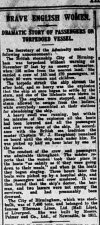
On the 27 November 1916 the steam cargo ship, City of Birmingham was torpedoed abou 90 nautical miles off the coast of Malta. Four casualties.
https://www.benjidog.co.uk/Tower Hill/WW1 Cito to Civilian.php
Brave English women.
https://www.benjidog.co.uk/Tower Hill/WW1 Cito to Civilian.php
Brave English women.