• Welcome to this forum . We are a worldwide group with a common interest in Birmingham and its history. While here, please follow a few simple rules. We ask that you respect other members, thank those who have helped you and please keep your contributions on-topic with the thread.

    We do hope you enjoy your visit. BHF Admin Team

First Railways In The Midlands

Heartland

master brummie
The first railways in this region were generally canal tram roads that linked coal mines, ironstone mines, furnaces and limestone mines with the Birmingham Canal Navigations. Track was either edge rail or plate rail, and horse haulage the preferred mode of traction.

The Kingswinsford, or Shut End Railway, was the first to use a locomotive (Agenoria) and this worked along a level section of track placed between two inclines. This railway ran to the Staffordshire & Worcestershire Canal.

Often there was little infrastructure involved and with their passing little trace remained. This was particularly true with many coal pit tramways whose routes changed as one pit closed and another opened.
 
By chance I was at the National Rail museum on thursday last, and took this photo of the Agenoria. It was dificult to get a good shot without other items iintruding.
DSCN1682 agenoria.jpg
 
I have always wondered if the chimney was that tall at first. There may have been a, engineering reason, such as a draught for the boiler, yet contemporary steam engines have shorter chimneys. The tall chimney may have been the result of it being used as a stationary boiler after it was retired from regular use. That happened when the two inclines were by-passed by other tracks and locomotives worked through to the canal basin.
 
In addition to the Shut End Railway. another local line was the Statford & Moreton Railway, engineered by William James which was like the Shut End line, composed of iron rails laid on stone blocks. That railway started at Bancroft Basin in Stratford upon Avon and went as far as Moreton in the Marsh. Later there was a branch to Shipston. Unlike the Shut End Railway, the railway to Moreton was horse drawn.

William James had plans for other railway schemes and was involved, before his bankruptcy, with the survey of the Liverpool & Manchester Railway. Being involved with different business interests James is said to have been involved with too many at the same time. His railway engineering projects had the potential to develop into a network of lines, but only the line to Moreton was built.
 
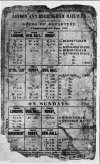
Early timetable, 1838, London to Birmingham Railway.

“THROUGH the kindness of Mr. W. J. Ford, of Welling-borough, we are able to put before our readers a reproduction of a very early time-table of the London and Birmingham Railway. It is printed on thin cardboard and measures approximately 8in. by 13in.
The date, it will be seen, is June 4th, 1838, only a few weeks after the connection to Birmingham had been opened, but whilst it was still incomplete. It will be noticed that at the period of this card Rugby and Denbigh Hall were only connected by coach, the thirty-five miles of line between these two places not being finished till the following September, " Denbigh Hall’’ was used as the name of a station, apparently for a comparatively short time, the name having certainly been changed to Bletchley before 1840. Denbigh Hall, it is interesting to recall, was originally the name of a famous inn not far from Bletchley. There are still many survivals in railway nomenclature of a similar kind—notably the Elephant and Castle Station near London—but in the early days of railways, when the coach was hardly yet displaced, the names of inns had far more significance than at present. Denbigh Hall had, however, we believe, become a recognised name of a village or locality, just as, to take a somewhat similar instance, the Crystal Palace now has, before the railway adopted it.”
(The Engineer, Jan 1909)


IMG_2287.jpeg
 
Back
Top