• Welcome to this forum . We are a worldwide group with a common interest in Birmingham and its history. While here, please follow a few simple rules. We ask that you respect other members, thank those who have helped you and please keep your contributions on-topic with the thread.

    We do hope you enjoy your visit. BHF Admin Team

Calthorpe Road

Vivienne14

Kentish Brummie Moderator
Staff member
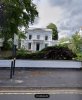
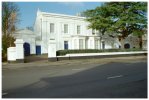
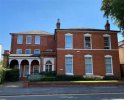
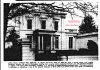
What a joy to see Calthorpe Road buildings being maintained to a high standard. This beauty, Ashley House, dates back to the 1830s. Isn’t it refreshing to see it retains its original features and character, well at least externally ? I doubt the interior will have too many original features if it’s been used for office accommodation, but could be wrong on that.

Ashley House isn’t the only house in this style and age on Calthorpe Road. And they’re similarly well maintained. Viv.5349B412-5756-4E8D-86FC-E2122068A2DD.jpeg
ED49E8C9-B2BC-42A6-AF03-5CDBC8B29073.jpeg
 
For a mention of 38 Calthorpe Road see the Thread “Hiroshima”…

 
What a joy to see Calthorpe Road buildings being maintained to a high standard. This beauty, Ashley House, dates back to the 1830s. Isn’t it refreshing to see it retains its original features and character, well at least externally ? I doubt the interior will have too many original features if it’s been used for office accommodation, but could be wrong on that.

Ashley House isn’t the only house in this style and age on Calthorpe Road. And they’re similarly well maintained. Viv.View attachment 152182

View attachment 152181
Viv I walked past this house many times in the 60's all the houses on this road and very attractive
 
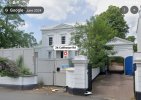
38 Calthorpe Road was not only remarkable because of three key figures, Peieris, Frisch and Fuchs associated with the nuclear project, but also for Professor Charles Lapworth who was Professor of Geology at Mason College and later the University of Birmingham from 1881 to 1913. He lived at this address from sometime after 1901 until his death in 1920.

He was one of the most influential geologists of the Victorian and Edwardian period, and is best known for establishing the Ordovician Period as a distinct geological system.
 
Along with several other Grade II listed houses in Calthorpe Road, numbers 37 and 38 Calthorpe Road were originally designed as impressive domestic villas. Several are now in commercial hands.

Below is the Historic England listing for #37 and #38 Calthorpe Road:

CALTHORPE ROAD 1. 5104 Edgbaston B15 Nos 37 and 38 SP 0585 NW 39/30 II GV C1835 designed as one composition: a pair of semi-detached stucco 2-storey villas with attendant coachhouses. Each has 3 bay front articulated by giant Tuscan pilasters, coupled at centre making the division. The giant order supports entablature with projecting cornice and blockingcourse raised in panel over entrance bays. Glazing bar sash windows in architrave surrounds. C1860 canted pilastered bay windows added to inner bays of each front on ground floor. Pilastered doorways with panelled reveals, looped glazing pattern to rectangular fanlights. Single storey pedimented and pilastered coachhouses are linked by screen walls pieced by segmental arched side entrances, to the corner of each house.

Image from Historic England.Screenshot_20260614_132458_Chrome.jpg
 
Last edited:
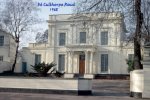
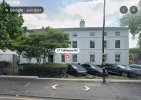
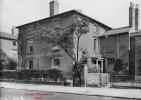
Next door at #36 is another Historic England Grade II listed house, a nicely proportioned Georgian house built c1829/30. Phyllis Nicklin captured it in 1968. It was once the HQ of the Midlands National Federation of Building Trades Employers. In the 2024 Streetview it was boarded up. Screenshot_20260614_134514_Chrome.jpg
Screenshot_20260614_171612_Maps.jpg

This is the Historic England listing documenting some lovely details:

CALTHORPE ROAD 1. 5104 Edgbaston E15 No 36 SP 0585 NW 39/29 21.1.70 II* GV 2. c1835, a richly decorated Graeco-Egyptian detached villa set back from road. 2-storeys stucco front, a 3 bay main block with subsidiary one storey single bay wings. Plinth; channelled ground floor with quoin piers; first floor sill course with the 3 bays framed by 4 pairs of Corinthian pilasters that support main entablature and projecting sections of parapet in with them. Monumental porch of coupled fluted Corinthian columns (on bases) on plinths of vermiculated rustication with steps rising between them; deep entablature with blocking course. Door in splayed Egyptian surround studded with rosettes, flanked by unfluted Corinthian pilasters. The windows on main block have similar "Egyptian" eaved architraves, studded with wreaths on ground floor and carried down to plinth, acanthus palmettes to caveto of cornices; plain on first floor with second stringcourse above cornices. The symmetrical wings have window panels flanked by plain pilaster strips towards house and by Corinthian pilasters inset from corners; entablatures surmounted by oversized parapet projecting above pilasters with central openwork panels of square section balusters. The garden front also on grand scale with slight breaks to centre and ends of channelled ground floor. First floor has 3 large eaved architrave windows set in panels between panelled pilaster strips, the eaves cornice and parapet with incised panels breaking forward in line with them. Left hand wing as an entrance front, right head simply as lean-to. Coupled pilasters to flanks of house. Corniced chimney stacks.
 
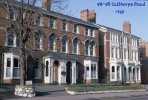
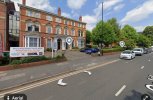
Phyllis Nicklin must have feared that some of these buildings might disappear. Fortunately, many along this road have survived. This must be, in part, down to their having listed status as well as being taken over to become commercial properties. A sad fact, but at least 8n tgat way they have survived demolition/redevelopment. This one, at #27 and #28 has had some alteration and now houses the ROSPA organisation.

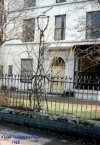
A very nice feature of this and a few of the neighbouring fences is the survival of the former oil street lamp fittings captured in Phyllis's photo below.

Screenshot_20260614_134535_Chrome.jpg
Screenshot_20260614_173547_Maps.jpg
 
Back
Top