• Welcome to this forum . We are a worldwide group with a common interest in Birmingham and its history. While here, please follow a few simple rules. We ask that you respect other members, thank those who have helped you and please keep your contributions on-topic with the thread.

    We do hope you enjoy your visit. BHF Admin Team

Barron Venetian Blind Manufacturers Lower Temple Street

RachaelMRodway

New Member
I am descended from John Barron, the first innkeeper of the Aston Cross Tavern. I understand that there is some connection with the Venetian Blind Manufacturers. Does anybody know about this?
 
Rachel,

Given that we are dealing with the period 1775-1792 for his tenure, that may be a tall order.

Wrightson's Triennial Directory of Birmingham for 1815 shows this:-

Barron.jpg

British Liobrary Newspaper Archive shows no mention of this in Birmingham between 1775 amd 1853.
The London Gazette has nearly 5,000 entries for Barron & Co. between these dates, but add the location Birmingham and there are none!

Maurice :cool:
 
Last edited:
Good point! John Barron (son of the Innkeeper) was born in Birmingham in 1762; his daugher Susanna was married to John Rodway (who I think was an Alderman of Birmingham) in 1800. Anything that may help would be appreciated.
 
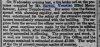
Don't know if you have seen these cuttings on the company. They show that in the 1820s-30s the company was run by a James Barron, but he could be the son.
Aris Birm Gaz.23.8.1830.jpgAris Birm Gazette,    10.10.1836.jpgAris Brim Gazette.     9.10.1826.jpgBirm Journal 9.9.1826.jpg
 
Rachel,

Since your relation is John and the blind maker is James, it would be advisable to see if there are christenings for both with same parents.

Maurice :cool:
 
Last edited:
In the 1839 Wrightson's Directory they seem to have combined with another :
Barron and Mills, brass founders, and manufacturers of improved brass rods, gauze wire and transparent window blinds; also factors and merchants,
25, Lower Temple-street, and 72 and 73, Wells-st. Oxford-st. London.
They are not listed in Pigots 1841 directory
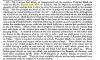
By 1839 they are described (see attached , at https://books.google.co.uk/books?id=AkEFimYNoxgC&pg=PA270&lpg=PA270&dq="Barron+and+Mills"&source=bl&ots=kQAUIPyxsf&sig=ACfU3U0wbS5E_QgE7f7oFCWRKeUjzchAnA&hl=en&sa=X&ved=2ahUKEwib5JmC8dbnAhUIQEEAHZXPCeQQ6AEwAnoECAgQAQ#v=onepage&q="Barron and Mills"&f=false)
as "of London", so maybe the firm moved to London

From: https://s3.amazonaws.com/hpef-digit...+Rehab+Guide-2-History+and+Technology-ocr.pdf :

The spring roller was a recent advance, and because of its extra cost,Loudon felt it suitable for villas only.12 It wasstill so novel in 1844 that Webster and Parkes felt the need to define it for readers:
Spring roller blinds have a wire spring inside a tin roller, which acts so as to tum it, and the blind is raised up by merely pulling a cord: these are much more expensive than the common rollerblind, which has the advantage of greater simplicity, and being less apt to be out of order. 13
According to Loudon, the best spring rollers were made by Barron and Mills.

An Encyclopaedia of Cottage, Farm, and Villa Architecture and Furniture.jpg
 
have moved this thread from the forum rules section to the correct section of the forum
 
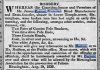
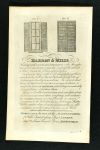
To add to above posts - Some more info about Barron & Mills: from advert dated 1830.
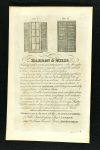
1767969201681.png 1767969404809.png
Advert c1830s

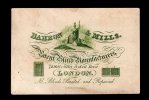
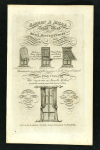
Trade card 1830s1767970584568.jpeg

This is for sale on Abe Books - have copied their description as it gives quite a bit of info about firm.

James Barron first appears in the records in Holden's 'Triennial Directory' for the years 1805 to 1807, where he is listed as a Venetian blind maker active at Edgbaston Street, Birmingham. In 1820, Barron, who then occupied 73 Wells Street, London and 11 Lower Temple Street, Birmingham published a pamphlet addressed "to cabinet-makers and upholsterers in general" and entitled "Modern and Elegant Designs of Cabinet & Upholstery Furniture". The bulk of the work was taken up with charming illustrations of various pieces of furniture, and also included a explanation of "Barron's Patent Roller Blinds", a list of materials used and stocked by Barron at his shops, as well as a price list. 'The London Upholsterer's Companion' of 1834 lists Barron and Mills of both 72 and 73 Wells Street as "Venetian and Spring Blind Makers". In 1842, however 'Robson's London Directory' lists Mills there with a new partner named De Wilde. Just the following year, the first volume of 'The Builder', one of Britain's longest running business-to-business magazine which remains in print today as 'Building', contained an advertisement for "F. A. De Wilde, Twenty Years with and Successor to Barron and Mills". Five years later, however, The London Gazette announced De Wilde's insolvency, and by 1853, another blind maker named H.W.Fields had taken over the premises at Number 72. The Birmingham property still retained by Barron later became 'W. Hopkins & Son'. It appears, therefore, that Barron had established himself as blind maker during the early decades of the nineteenth century before entering into a partnership with Mills, who may have been his apprentice and who later formed a new partnership with De Wilde, probably following Barron's death in 1839. The present trade card gives the name and address of the business, and announces that not only does it sell blinds for domestic use and exportation, but also offers repair services. It is illustrated with two simple engravings of different types of blinds, one with vertical vanes and the other horizontal, as well as with the personification of Britannia standing proudly on the shore with her staff and shield, bearing the Union Flag. Engraved by Thomas Smith.

Amazing that can find this amount of info about an early 19c. Birmingham firm from simple on-line checking.

 

Attachments

  • 1767969232037.png
    1767969232037.png
    1.5 MB · Views: 1
Last edited:
Back
Top