

-
Welcome to this forum . We are a worldwide group with a common interest in Birmingham and its history. While here, please follow a few simple rules. We ask that you respect other members, thank those who have helped you and please keep your contributions on-topic with the thread.
We do hope you enjoy your visit. BHF Admin Team
You are using an out of date browser. It may not display this or other websites correctly.
You should upgrade or use an alternative browser.
You should upgrade or use an alternative browser.
Aston Hall Road (formerly Aston Lane)
- Thread starter G G Jean
- Start date
Ben Rudder
New Member
Hi John, Lyn
Thanks very much for your help. Absolutely brilliant.
I've got a much better insight thanks to your help. I can now see the whole site, fit it together with the complicated history of the various companies and places, and have a couple more fragments of information to add in.
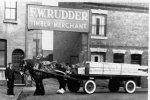
The photo below, which I was reminded of only a month ago, can now definitively be placed outside the entrance to the yard at 38 Sutherland Street. And I'll show below that I think you can actually see the sign from John's aerial view too.
Note first the upper window height of the signboard, the large windowless external house wall at No 40 (making up the right of the alley entrance), and the right edge of a tall construction in the distance down the alley, in line vertically with the neck harness of the horse.
(The tall distant building has a different pattern of brickwork to the much closer house wall of No 36 to which the sign is attached -- even though the eye is deceived a little.)
The cropped image below, from John's link [www.britainfromabove.org.uk EAW045932 ENGLAND (1952)], shows the entire area of the two yards, The Aston Hall Rd access is at the top right, and the Sutherland St access in the bottom right. And I think the signboard can be picked out at the right-angle corner on Sutherland St -- at the very bottom of the photo, and to the right side.
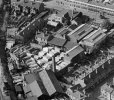
The alleyway to the works -- (running right-to-left and upwards at 30 degrees in the photo) -- continues along the line of the southern part of Sutherland St. The alley then passes the sunny windowless side-wall of the end-terrace house at No 40, then past No 40's's back yard and on towards the large standalone chimney stack where the alley joins the worksheds.
I think the signboard can be seen as a diagonal dark bar at upper-window height between No 36 and No 40, just as in the carthorse photo. The sun on the wall behind can be seen above and below the dark bar, as one would expect from the horse photo.
And if one scrolls back up to the horse photo again, the tall large construction seen down the alley behind the horse's neck is actually part of the tall chimney stack seen at the end of the alleyway in the aerial shot. The chimney has the same banded brickwork as partly seen in the horse photo.
I have no date for the horse photo, and would be interested to know what anyone thinks.
I do know that FW had a fondness for horses, and that he also had a side business recommending horses for sale to his friends and business contacts. He died in 1925, so perhaps a 1920-ish date is about right. There are perhaps four faces looking on from the alleyway, so the picture doesn't seem to be a professional publicity shot. But the driver (and the horse and wagon) are definitely posing, so the picture was not likely taken just by a passing stranger. Plus that, the photo somehow found its way into my paternal aunt's box of old photos, making one think the photographer might be someone else from the works, and that the occasion might not be just a normal working day.
Was the picture taken by or for FW himself before his death, or by CJ afterwards in honour of his late brother's fanciful transport arrangements.
The tyres are a puzzle to me. Are they really factory white-walls or have they just been given a lick of white paint for show?
FW's regular customers included the Dunlop factory (started operations around 1917) -- so I suppose it's vaguely possible he scrounged some factory cast-offs.
I don't remember ever seeing photos of white tyres on ordinary transport vehicles of the period, so maybe it was a sales gimmick rather than something to make the wagon stand out in the dark.
Could the white walls even be a jokey reference to the speed of posh racing cars people might have seen on silent newsreels? Or is the whole display a sentimental whimsy to mark the passing of the age of works stables, and an act of hopeless resistance to a brave new transport world of exhaust fumes and, in some nightmarish future, the dull endless roar of a nearby new-fangled motorway overpass?
Among the few things passed down to my generation were a pair of 2ft-long brass-studded harness straps that might be in the horse photo. I don't know anything about harnesses so can only guess what they might be for. They seem at first to be purely decorative -- because there is only one buckle on the top of each, with no obvious method of linkage at the bottom.
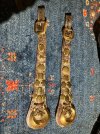
The blazing sun or star-shapes inside the FWR horseshoes are actually attached within the shoe-shape, and the FWR "shoes" are not solid brass, so they make no sense as handles, and would be much too small for a boot even if the stars weren't there. The whole FWR-shoe and star assembly hangs loose from a relatively flimsy leather hinge above, like symbolic but utterly useless stirrups.
Going back for a final time to the horse photo, there *is* one similarly shaped bright strap hanging down from the rear of the area on the horse's back where a standard saddle would sit. The pear-ended strap doesn't seem to serve any mechanical purpose for the wagon shaft, whose main forces act through its attachment at the horse's neck and shoulders. However, if the drivers had to move up the shaft from the moving wagon in an emergency, or sometimes had to haul themselves up onto the horse's back from the ground, the straps might have been handy to hold on to. But does that really make any sense given their decorative and apparently dysfunctional nature?
Strangely, gripping the whole pear-shaped bottom part, (leather and brass decoration together), feels quite comfortable in the hand. And because the pear-end flares out, a pulling grip tends to tighten rather than slip. So did the straps occasionally serve to help the drivers pull themselves up to a driving position? -- where-ever that was. This only raises another question -- did the drivers always sit on the wagon or its load, or did they sometimes have to climb onto the shaft, or onto the horse's back, where the photo suggests there may be some cloth that might serve as a rudimentary saddle?
These brass straps are rather fine to the eye, but can hardly be considered an essential accessory for the tough job of carting timber around town all day in a damp gloomy November. This seems to prove that FWR was indeed both sentimental and a bit of a showman -- character traits certainly compatible with an extravagant attitude to business expenses.
So, if the horse decorations are a form of self-indulgence, do the symbols mean anything? Are they traditional types of decoration, just whimsical, or perhaps cryptically masonic? And were they possibly made in one of the local brassworks?
The rabbit-holes just keep opening up!
My sincere thanks for solving several baffling mysteries for me. And brava/bravo to members of this community for being such a great source of information and assistance.
Thanks very much for your help. Absolutely brilliant.
I've got a much better insight thanks to your help. I can now see the whole site, fit it together with the complicated history of the various companies and places, and have a couple more fragments of information to add in.
The photo below, which I was reminded of only a month ago, can now definitively be placed outside the entrance to the yard at 38 Sutherland Street. And I'll show below that I think you can actually see the sign from John's aerial view too.
Note first the upper window height of the signboard, the large windowless external house wall at No 40 (making up the right of the alley entrance), and the right edge of a tall construction in the distance down the alley, in line vertically with the neck harness of the horse.
(The tall distant building has a different pattern of brickwork to the much closer house wall of No 36 to which the sign is attached -- even though the eye is deceived a little.)
The cropped image below, from John's link [www.britainfromabove.org.uk EAW045932 ENGLAND (1952)], shows the entire area of the two yards, The Aston Hall Rd access is at the top right, and the Sutherland St access in the bottom right. And I think the signboard can be picked out at the right-angle corner on Sutherland St -- at the very bottom of the photo, and to the right side.
The alleyway to the works -- (running right-to-left and upwards at 30 degrees in the photo) -- continues along the line of the southern part of Sutherland St. The alley then passes the sunny windowless side-wall of the end-terrace house at No 40, then past No 40's's back yard and on towards the large standalone chimney stack where the alley joins the worksheds.
I think the signboard can be seen as a diagonal dark bar at upper-window height between No 36 and No 40, just as in the carthorse photo. The sun on the wall behind can be seen above and below the dark bar, as one would expect from the horse photo.
And if one scrolls back up to the horse photo again, the tall large construction seen down the alley behind the horse's neck is actually part of the tall chimney stack seen at the end of the alleyway in the aerial shot. The chimney has the same banded brickwork as partly seen in the horse photo.
I have no date for the horse photo, and would be interested to know what anyone thinks.
I do know that FW had a fondness for horses, and that he also had a side business recommending horses for sale to his friends and business contacts. He died in 1925, so perhaps a 1920-ish date is about right. There are perhaps four faces looking on from the alleyway, so the picture doesn't seem to be a professional publicity shot. But the driver (and the horse and wagon) are definitely posing, so the picture was not likely taken just by a passing stranger. Plus that, the photo somehow found its way into my paternal aunt's box of old photos, making one think the photographer might be someone else from the works, and that the occasion might not be just a normal working day.
Was the picture taken by or for FW himself before his death, or by CJ afterwards in honour of his late brother's fanciful transport arrangements.
The tyres are a puzzle to me. Are they really factory white-walls or have they just been given a lick of white paint for show?
FW's regular customers included the Dunlop factory (started operations around 1917) -- so I suppose it's vaguely possible he scrounged some factory cast-offs.
I don't remember ever seeing photos of white tyres on ordinary transport vehicles of the period, so maybe it was a sales gimmick rather than something to make the wagon stand out in the dark.
Could the white walls even be a jokey reference to the speed of posh racing cars people might have seen on silent newsreels? Or is the whole display a sentimental whimsy to mark the passing of the age of works stables, and an act of hopeless resistance to a brave new transport world of exhaust fumes and, in some nightmarish future, the dull endless roar of a nearby new-fangled motorway overpass?
Among the few things passed down to my generation were a pair of 2ft-long brass-studded harness straps that might be in the horse photo. I don't know anything about harnesses so can only guess what they might be for. They seem at first to be purely decorative -- because there is only one buckle on the top of each, with no obvious method of linkage at the bottom.
The blazing sun or star-shapes inside the FWR horseshoes are actually attached within the shoe-shape, and the FWR "shoes" are not solid brass, so they make no sense as handles, and would be much too small for a boot even if the stars weren't there. The whole FWR-shoe and star assembly hangs loose from a relatively flimsy leather hinge above, like symbolic but utterly useless stirrups.
Going back for a final time to the horse photo, there *is* one similarly shaped bright strap hanging down from the rear of the area on the horse's back where a standard saddle would sit. The pear-ended strap doesn't seem to serve any mechanical purpose for the wagon shaft, whose main forces act through its attachment at the horse's neck and shoulders. However, if the drivers had to move up the shaft from the moving wagon in an emergency, or sometimes had to haul themselves up onto the horse's back from the ground, the straps might have been handy to hold on to. But does that really make any sense given their decorative and apparently dysfunctional nature?
Strangely, gripping the whole pear-shaped bottom part, (leather and brass decoration together), feels quite comfortable in the hand. And because the pear-end flares out, a pulling grip tends to tighten rather than slip. So did the straps occasionally serve to help the drivers pull themselves up to a driving position? -- where-ever that was. This only raises another question -- did the drivers always sit on the wagon or its load, or did they sometimes have to climb onto the shaft, or onto the horse's back, where the photo suggests there may be some cloth that might serve as a rudimentary saddle?
These brass straps are rather fine to the eye, but can hardly be considered an essential accessory for the tough job of carting timber around town all day in a damp gloomy November. This seems to prove that FWR was indeed both sentimental and a bit of a showman -- character traits certainly compatible with an extravagant attitude to business expenses.
So, if the horse decorations are a form of self-indulgence, do the symbols mean anything? Are they traditional types of decoration, just whimsical, or perhaps cryptically masonic? And were they possibly made in one of the local brassworks?
The rabbit-holes just keep opening up!
My sincere thanks for solving several baffling mysteries for me. And brava/bravo to members of this community for being such a great source of information and assistance.

nice post ben..i enjoyed reading it and thanks for the photos ..i also wonder if the symbols on the harnesses actually mean something...i take it that you are a decendant of F W RUDDERS...maybe family was in the free masons ? they certainly look as though they could be..having said that i thought that they did not really advertise it if they were members...something to ponder on..have look at this google link..cooking dinner at the min so i have a look later onHi John, Lyn
Thanks very much for your help. Absolutely brilliant.
I've got a much better insight thanks to your help. I can now see the whole site, fit it together with the complicated history of the various companies and places, and have a couple more fragments of information to add in.
The photo below, which I was reminded of only a month ago, can now definitively be placed outside the entrance to the yard at 38 Sutherland Street. And I'll show below that I think you can actually see the sign from John's aerial view too.
Note first the upper window height of the signboard, the large windowless external house wall at No 40 (making up the right of the alley entrance), and the right edge of a tall construction in the distance down the alley, in line vertically with the neck harness of the horse.
(The tall distant building has a different pattern of brickwork to the much closer house wall of No 36 to which the sign is attached -- even though the eye is deceived a little.)
View attachment 228921
The cropped image below, from John's link [www.britainfromabove.org.uk EAW045932 ENGLAND (1952)], shows the entire area of the two yards, The Aston Hall Rd access is at the top right, and the Sutherland St access in the bottom right. And I think the signboard can be picked out at the right-angle corner on Sutherland St -- at the very bottom of the photo, and to the right side.
View attachment 228923
The alleyway to the works -- (running right-to-left and upwards at 30 degrees in the photo) -- continues along the line of the southern part of Sutherland St. The alley then passes the sunny windowless side-wall of the end-terrace house at No 40, then past No 40's's back yard and on towards the large standalone chimney stack where the alley joins the worksheds.
I think the signboard can be seen as a diagonal dark bar at upper-window height between No 36 and No 40, just as in the carthorse photo. The sun on the wall behind can be seen above and below the dark bar, as one would expect from the horse photo.
And if one scrolls back up to the horse photo again, the tall large construction seen down the alley behind the horse's neck is actually part of the tall chimney stack seen at the end of the alleyway in the aerial shot. The chimney has the same banded brickwork as partly seen in the horse photo.
I have no date for the horse photo, and would be interested to know what anyone thinks.
I do know that FW had a fondness for horses, and that he also had a side business recommending horses for sale to his friends and business contacts. He died in 1925, so perhaps a 1920-ish date is about right. There are perhaps four faces looking on from the alleyway, so the picture doesn't seem to be a professional publicity shot. But the driver (and the horse and wagon) are definitely posing, so the picture was not likely taken just by a passing stranger. Plus that, the photo somehow found its way into my paternal aunt's box of old photos, making one think the photographer might be someone else from the works, and that the occasion might not be just a normal working day.
Was the picture taken by or for FW himself before his death, or by CJ afterwards in honour of his late brother's fanciful transport arrangements.
The tyres are a puzzle to me. Are they really factory white-walls or have they just been given a lick of white paint for show?
FW's regular customers included the Dunlop factory (started operations around 1917) -- so I suppose it's vaguely possible he scrounged some factory cast-offs.
I don't remember ever seeing photos of white tyres on ordinary transport vehicles of the period, so maybe it was a sales gimmick rather than something to make the wagon stand out in the dark.
Could the white walls even be a jokey reference to the speed of posh racing cars people might have seen on silent newsreels? Or is the whole display a sentimental whimsy to mark the passing of the age of works stables, and an act of hopeless resistance to a brave new transport world of exhaust fumes and, in some nightmarish future, the dull endless roar of a nearby new-fangled motorway overpass?
Among the few things passed down to my generation were a pair of 2ft-long brass-studded harness straps that might be in the horse photo. I don't know anything about harnesses so can only guess what they might be for. They seem at first to be purely decorative -- because there is only one buckle on the top of each, with no obvious method of linkage at the bottom.
View attachment 228925
The blazing sun or star-shapes inside the FWR horseshoes are actually attached within the shoe-shape, and the FWR "shoes" are not solid brass, so they make no sense as handles, and would be much too small for a boot even if the stars weren't there. The whole FWR-shoe and star assembly hangs loose from a relatively flimsy leather hinge above, like symbolic but utterly useless stirrups.
Going back for a final time to the horse photo, there *is* one similarly shaped bright strap hanging down from the rear of the area on the horse's back where a standard saddle would sit. The pear-ended strap doesn't seem to serve any mechanical purpose for the wagon shaft, whose main forces act through its attachment at the horse's neck and shoulders. However, if the drivers had to move up the shaft from the moving wagon in an emergency, or sometimes had to haul themselves up onto the horse's back from the ground, the straps might have been handy to hold on to. But does that really make any sense given their decorative and apparently dysfunctional nature?
Strangely, gripping the whole pear-shaped bottom part, (leather and brass decoration together), feels quite comfortable in the hand. And because the pear-end flares out, a pulling grip tends to tighten rather than slip. So did the straps occasionally serve to help the drivers pull themselves up to a driving position? -- where-ever that was. This only raises another question -- did the drivers always sit on the wagon or its load, or did they sometimes have to climb onto the shaft, or onto the horse's back, where the photo suggests there may be some cloth that might serve as a rudimentary saddle?
These brass straps are rather fine to the eye, but can hardly be considered an essential accessory for the tough job of carting timber around town all day in a damp gloomy November. This seems to prove that FWR was indeed both sentimental and a bit of a showman -- character traits certainly compatible with an extravagant attitude to business expenses.
So, if the horse decorations are a form of self-indulgence, do the symbols mean anything? Are they traditional types of decoration, just whimsical, or perhaps cryptically masonic? And were they possibly made in one of the local brassworks?
The rabbit-holes just keep opening up!
My sincere thanks for solving several baffling mysteries for me. And brava/bravo to members of this community for being such a great source of information and assistance.
lyn