gingerjon
GONE BUT NOT FORGOTTEN R.I.P.
A bit of Aston History
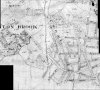
The Aston Brook mills were built to supply industrial power from the start. Work Mill (Aston Brook Mill and other names) was engaged in cloth-fulling by 1532, and Aston Furnace began operations in 1615, its bellows worked by water. A leat which may have been a natural channel fed a long narrow pool. John Jennens of Erdington Hall owned the Furnace and another at Bromford, producing 400 tons of pig iron annually from the two. After a hundred and fifty years of dumping the spoil bank between tailrace and brook was half the size of the pool. (Some of the clinker was used by Richard Ford to build 'Hockley Abbey', a folly ruin, about 1780). Spooner and Wright, at the Furnace, were using a Newcomen engine after 1768, because the brook's supply was inadequate. Matthew Boulton was having the same trouble at Soho Works upstream: at both sites steam power was used to pump water back to the headpool for continued re-use by the wheels. The Furnace was blown out in 1783. A steam-powered papermill was at work on the site in 1833, and for about five years from 1845 the premises were used for wire-drawing. By 1865 the firm had moved to new buildings in Alma Street, still called 'Aston Furnace Mills'. The old works had been demolished by 1887: they had stood at the dip on Porchester Street. Crocodile Works now occupies the millsite.
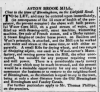
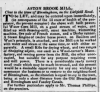
Aston Brook Mill stood just above the Lichfield Road ford, south of Phillips Street. The Expressway now cuts right through its site. It was a fulling mill in 1532 and 1585. On Beighton's map of 1725 it is called Bourn Work Mill. In 1758 it was Gisbourn's and in 1791 Hooper's Mill. At about that time it may have reverted to corn-grinding when the shortage of waterpower locally for that purpose made it profitable. Water was very scarce: fifty-odd mills were hoarding it within the area of the modern City. By 1830 waterpower had perforce been supplemented. Bourn Mill was steam-powered for timber cutting and turning, while still using its waterwheels for corn. A disastrous fire in 1862 brought its working life to an end, and the buildings were demolished when local streets were built. Steel's Mill, shown as 'Blade Mill' by Beighton, was fed by a leat from the brook. No pool is marked on the 1758 map, and though little power was needed for edging blades and tools there was probably too little even for that without a reserve. In the 1780s the Fazeley Canal cut across its site, which today would be at the Wharf Street/ Wainwright Street corner. No windmills have been mapped in Aston. If one existed, the obvious site would be on the summit south of the Hall.
explanation (a mill for fulling cloth as by means of pesties or stampers, which alternately fall into and rise from troughs where the cloth is placed with hot water and fuller's earth, or other cleansing materials.)
The Aston Brook mills were built to supply industrial power from the start. Work Mill (Aston Brook Mill and other names) was engaged in cloth-fulling by 1532, and Aston Furnace began operations in 1615, its bellows worked by water. A leat which may have been a natural channel fed a long narrow pool. John Jennens of Erdington Hall owned the Furnace and another at Bromford, producing 400 tons of pig iron annually from the two. After a hundred and fifty years of dumping the spoil bank between tailrace and brook was half the size of the pool. (Some of the clinker was used by Richard Ford to build 'Hockley Abbey', a folly ruin, about 1780). Spooner and Wright, at the Furnace, were using a Newcomen engine after 1768, because the brook's supply was inadequate. Matthew Boulton was having the same trouble at Soho Works upstream: at both sites steam power was used to pump water back to the headpool for continued re-use by the wheels. The Furnace was blown out in 1783. A steam-powered papermill was at work on the site in 1833, and for about five years from 1845 the premises were used for wire-drawing. By 1865 the firm had moved to new buildings in Alma Street, still called 'Aston Furnace Mills'. The old works had been demolished by 1887: they had stood at the dip on Porchester Street. Crocodile Works now occupies the millsite.
Aston Brook Mill stood just above the Lichfield Road ford, south of Phillips Street. The Expressway now cuts right through its site. It was a fulling mill in 1532 and 1585. On Beighton's map of 1725 it is called Bourn Work Mill. In 1758 it was Gisbourn's and in 1791 Hooper's Mill. At about that time it may have reverted to corn-grinding when the shortage of waterpower locally for that purpose made it profitable. Water was very scarce: fifty-odd mills were hoarding it within the area of the modern City. By 1830 waterpower had perforce been supplemented. Bourn Mill was steam-powered for timber cutting and turning, while still using its waterwheels for corn. A disastrous fire in 1862 brought its working life to an end, and the buildings were demolished when local streets were built. Steel's Mill, shown as 'Blade Mill' by Beighton, was fed by a leat from the brook. No pool is marked on the 1758 map, and though little power was needed for edging blades and tools there was probably too little even for that without a reserve. In the 1780s the Fazeley Canal cut across its site, which today would be at the Wharf Street/ Wainwright Street corner. No windmills have been mapped in Aston. If one existed, the obvious site would be on the summit south of the Hall.
explanation (a mill for fulling cloth as by means of pesties or stampers, which alternately fall into and rise from troughs where the cloth is placed with hot water and fuller's earth, or other cleansing materials.)