• Welcome to this forum . We are a worldwide group with a common interest in Birmingham and its history. While here, please follow a few simple rules. We ask that you respect other members, thank those who have helped you and please keep your contributions on-topic with the thread.

    We do hope you enjoy your visit. BHF Admin Team

A visit to the Doctor.

Patient records are confidential except in very specific circumstances. Here's a quick summary of position:

Can anyone else see my records?

Your health records are confidential. The NHS shouldn't show your health records to anyone without your consent. Unless they share information with other NHS or social care staff members who are involved in your care.
that what i said anyone in nhs can login and have a look. i went to the chemist, he said i will have alook at your med history. i went to the hospital they said the same, the rec at the quacks can. if joe blocks gets the password he too can have a look. i think i am going to ask to opt out of the club
 
Dr Francis owned the surgery on the corner of Weoley Castle Road, It was a big white house, he had his own honey hives. Rode a bike and had a dark beard.
 
Last edited by a moderator:
a visit to our doc you seen the recepionist who looked your name up from a few cards in a wooden draw she gave you the card and you sat in a converted front room of the docs house that had a gas fire when it was your turn in you went give the doc the card:grinning:
 
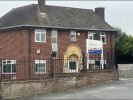
This thread opens up lots of possibilities. Our GP when I was young was Dr Ezzat. His practice was a fairly large but poorly adapted house on the corner of Court Oak Road and Tennal Lane. There were no appointments and you would simply take the next available chair and wait your turn. Good job we were trained to queue from birth! The waiting room must have once been a sitting room or perhaps dining room. The chairs were a random mix of wooden dining chairs, but none of them was particularly comfortable. As the buzzer went (I think it was a buzzer) for the next patient, we would all move along one chair. I can picture the room very clearly even now. There was nothing warm or inviting or interesting about it. When you were called through, you would walk along a short corridor and knock on the door of the consulting room, already slightly high on the whiff of antiseptic. Dr Ezzat was a large, fairly genial Egyptian who knew all of my family and was prone to give advice on a range of things, whether you wanted it or not. My clearest recollection of him is when he treated me for a severe gash to my knee caused by newly pruned and dagger-like privet hedge at my Grand-dads house. I still have the scar, but I did not develop an infection.
My 1960-70s memory of Dr Ezzat.
My blind trust in the UK’s National Health Service was forged during childhood, built on the back of my mother’s frequent inpatient hospital stays and our regular visits to the family doctor. Whenever Mom, me, and my two younger brothers had health issues, she would march us from our home in Capern Grove, left into Welsh House Farm Road, left again at Tennal Road, and right into Tennal Lane. Our destination was number two: the surgery of Dr Ezzat, who practised out of a converted interwar house built somewhere between 1920 and 1935.

Access was gained through a large timber gate, along a short path bordered by shrubs and trees, and up a couple of steps to an imposing Georgian/Art Deco portalled front door. Immediately inside, patients stood on immaculately polished, dark brown linoleum that ran throughout the building. We reported to a receptionist, summoning her attention by pressing a doorbell mounted on a cream-painted timber and obscure-glazed partition wall. A small sliding hatch would snap open; you announced your name and were told to go to the waiting room on the right.

The high-ceilinged, cream gloss-painted room had two heavily curtained windows to the right and another at the far end. There was a boarded-up fireplace to the left, and a centre table piled with ancient magazines, including Reader’s Digest.

Upon entering, you took your place on the first of many mismatching, dark Thonet bentwood dining chairs lining the room. If there were no chairs available, you stood. They creaked as you sat down and shifted your weight on the small, round, hard relief-patterned seats.

A buzzer proclaimed when the doctor was available for the next patient. The person sitting next to the inner door—on the same wall you had entered through—would get up, open the door, and vanish. Everyone else then moved along one seat, like a sombre game of musical chairs.

It could take a few hours waiting your turn in that gloomy, overheated room filled with crying babies and coughing, sneezing people. Finally, your chance arrived to proceed along a passage behind the records-reception room. You would knock on the doctor’s door, await a muffled 'Enter', and step into a bright, white gloss-painted room with a window overlooking the west-facing garden.

The doctor sat at a large, heavy, dark timber desk on the left, beneath a wall-mounted cupboard. You were invited to sit to their left. Dr Ezzat would turn to face you in a dark, padded leather swivel chair that had seen better days. 'Mother, what can we do for you today?' he would ask. This ageing, gentle, kind, and direct Egyptian man listened intently. He inspected chests with a cold stethoscope and checked tongues and throats with a routine 'Say argh'—seemingly his remedy for all ailments.

Exiting past chrome-framed, glazed cabinets housing disturbing-looking medical instruments brought you right back to the entrance. When I grew older, I went to the doctor alone. I trusted him completely and felt safe in his care.

 
This thread opens up lots of possibilities. Our GP when I was young was Dr Ezzat. His practice was a fairly large but poorly adapted house on the corner of Court Oak Road and Tennal Lane. There were no appointments and you would simply take the next available chair and wait your turn. Good job we were trained to queue from birth! The waiting room must have once been a sitting room or perhaps dining room. The chairs were a random mix of wooden dining chairs, but none of them was particularly comfortable. As the buzzer went (I think it was a buzzer) for the next patient, we would all move along one chair. I can picture the room very clearly even now. There was nothing warm or inviting or interesting about it. When you were called through, you would walk along a short corridor and knock on the door of the consulting room, already slightly high on the whiff of antiseptic. Dr Ezzat was a large, fairly genial Egyptian who knew all of my family and was prone to give advice on a range of things, whether you wanted it or not. My clearest recollection of him is when he treated me for a severe gash to my knee caused by newly pruned and dagger-like privet hedge at my Grand-dads house. I still have the scar, but I did not develop an infection.
 
hi roboz what a lovely description of visiting your doctor..gone are the days when we could just turn up and wait our turn...its nice to see that the building is still caring for children

lyn
 
Yes. Dr Ezzat was a lovely doctor and I always felt very comfortable when he had to check things out. I guess I went there from about 1963 through to the mid-70s when I think he must have retired and we moved to the Lordswood Rd practice with Drs Dewsbury, Benn etc.
I have often wondered how Dr Ezzat came to be a GP in Birmingham, guessing that he probably re-located to the UK after WW2.
I too remember the queuing on the wooden chairs, his cold stethoscope, having to say "aagh!" etc.
I understood that the building was intended to have been a pub and may have actually been one for a very short time.
Chas
 
maybe we should combine this thread with the below one which makes interesting reading and gives my memories of our family doctors

lyn

 
My 1960-70s memory of Dr Ezzat.
My blind trust in the UK’s National Health Service was forged during childhood, built on the back of my mother’s frequent inpatient hospital stays and our regular visits to the family doctor. Whenever Mom, me, and my two younger brothers had health issues, she would march us from our home in Capern Grove, left into Welsh House Farm Road, left again at Tennal Road, and right into Tennal Lane. Our destination was number two: the surgery of Dr Ezzat, who practised out of a converted interwar house built somewhere between 1920 and 1935.

Access was gained through a large timber gate, along a short path bordered by shrubs and trees, and up a couple of steps to an imposing Georgian/Art Deco portalled front door. Immediately inside, patients stood on immaculately polished, dark brown linoleum that ran throughout the building. We reported to a receptionist, summoning her attention by pressing a doorbell mounted on a cream-painted timber and obscure-glazed partition wall. A small sliding hatch would snap open; you announced your name and were told to go to the waiting room on the right.

The high-ceilinged, cream gloss-painted room had two heavily curtained windows to the right and another at the far end. There was a boarded-up fireplace to the left, and a centre table piled with ancient magazines, including Reader’s Digest.

Upon entering, you took your place on the first of many mismatching, dark Thonet bentwood dining chairs lining the room. If there were no chairs available, you stood. They creaked as you sat down and shifted your weight on the small, round, hard relief-patterned seats.

A buzzer proclaimed when the doctor was available for the next patient. The person sitting next to the inner door—on the same wall you had entered through—would get up, open the door, and vanish. Everyone else then moved along one seat, like a sombre game of musical chairs.

It could take a few hours waiting your turn in that gloomy, overheated room filled with crying babies and coughing, sneezing people. Finally, your chance arrived to proceed along a passage behind the records-reception room. You would knock on the doctor’s door, await a muffled 'Enter', and step into a bright, white gloss-painted room with a window overlooking the west-facing garden.

The doctor sat at a large, heavy, dark timber desk on the left, beneath a wall-mounted cupboard. You were invited to sit to their left. Dr Ezzat would turn to face you in a dark, padded leather swivel chair that had seen better days. 'Mother, what can we do for you today?' he would ask. This ageing, gentle, kind, and direct Egyptian man listened intently. He inspected chests with a cold stethoscope and checked tongues and throats with a routine 'Say argh'—seemingly his remedy for all ailments.

Exiting past chrome-framed, glazed cabinets housing disturbing-looking medical instruments brought you right back to the entrance. When I grew older, I went to the doctor alone. I trusted him completely and felt safe in his care.
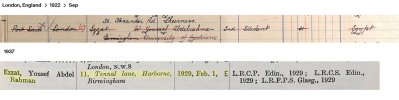
It appears Yousef Ezzat came to London from Egypt as a student in 1922 although I don't understand why his details are crossed through in red.

He is listed on the the medical register in 1929 but at 11 Tennal Lane. On the 1939 register he is at 2 Tennal Lane.
 

Attachments

  • dr-ezzat.jpg
    dr-ezzat.jpg
    97 KB · Views: 1
Back
Top