• Welcome to this forum . We are a worldwide group with a common interest in Birmingham and its history. While here, please follow a few simple rules. We ask that you respect other members, thank those who have helped you and please keep your contributions on-topic with the thread.

    We do hope you enjoy your visit. BHF Admin Team

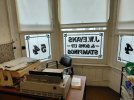
J.W.EVANS SILVER FACTORY

Astoness

TRUE BRUMMIE MODERATOR
Staff member
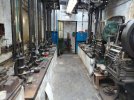
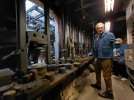
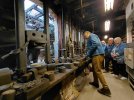
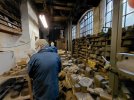
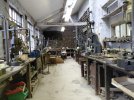
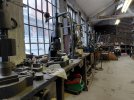
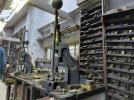
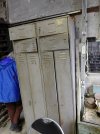
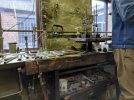
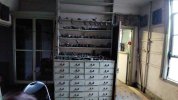
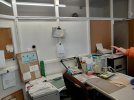
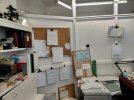
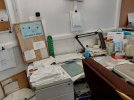
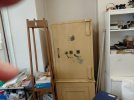
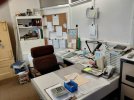
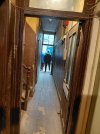
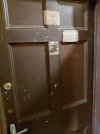
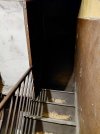
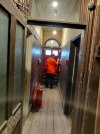
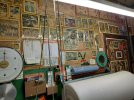
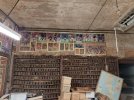
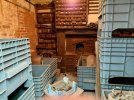
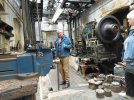
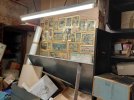
hi folks if you get the chance the tour of this factory is amazing..myself and our mikejee visited last week..everything left untouched when they sold to english heritage in 2008..even the old cooking range is still in situ in what used to be the kitchen when the evans family lived there ..the office of the last director tony evans left just as it was when he left on that last day including the large safe..one of the work rooms a shrine to aston villa..the smell just hit you as you walk in...there are a few short stairs to climb but manageable also they found a sealed up room which i think was used by member of the family to take photos of the evan family it was his dark room (mike will correct me if i have that wrong) and inside the secret room was the old camera he used... they do show us a photograph of the camera but english heritage are very strict about having the camera on show so it is in special storage ..sarah one of the guides was happy to take a chair around for those of us who find it difficult to stand for too long..nothing was too much trouble so please visit if you can it really is a fantastic time capsule dedicated to those who worked in such harsh conditions..here are a few photos which are great to have but to really appreciate this little gem you really need to see it for yourself

lyn
thumbnail - 2026-09-28T164956.227.jpegthumbnail - 2026-09-28T165019.971.jpegthumbnail - 2026-09-28T165046.105.jpegthumbnail - 2026-09-28T165110.833.jpegthumbnail - 2026-09-28T165135.462.jpegthumbnail - 2026-09-28T165159.829.jpegthumbnail - 2026-09-28T165217.763.jpeg
 
Last edited:
There are scattered accounts of the beginnings of J. W. Evans on several websites, but one of the most informative is the account of a visit linked below. According to that account, Evans was apprenticed to Levi & Salaman, who helped him establish his own business at 54 Albion Street in 1881. They appear to have retained an interest in the concern, which Evans had bought out entirely by 1908. Levi & Salaman continued separately, amalgamating with Barker Brothers in 1921.

Evans initially rented 54 Albion Street. An 1871 advertisement associated with J. Turner described it as spacious premises suitable for a butcher or pawnbroker. Earlier, in 1874, the block comprising numbers 54–57 was offered for sale following the death of Thomas Thornwell. The houses were described as freehold residences, each accommodating a large family, with the necessary out-offices and small back gardens.

The trade directories indicate a gradual expansion: J. W. Evans is initially listed at 54 Albion Street, subsequently at numbers 54 and 55, and later at 54, 55 and 56. This helps trace the business’s occupation of the adjoining premises, although the dates of their purchase, and when number 57 was added, remain to be established.

 
The story about Levi and Salaman was also told to us by the guides. Their explamation was that the firm realised that Evans would at sometime want to start out on his own. He was appreciated as an excellent craftsman and so , rather than him turning into a competitor, helped him statrt out on his own and still have availability of his work, though he also did work for others. It should be exphasised that the firm usually, and certainly in the beginning, only produced blanks of base metal, which were then sold to other firms who silver plated them.
 
A really fascinating place, all the more so for its preservation of the premises as left in 2008. I see Heritage England lists #54-#57 as Grade II listed.

It must have been great to visit, and the photos help those of us who can't visit. Thanks Lyn.

The artifacts span generations. The machinery alone must date from a wide cross-section of Evans' history. As must the products and tools lining the heaving shelves.

The lead cooking range (now rusty) for example, must have been on the premises from the early/mid 1800s, likely installed when it was domestic premises. One photo shows the balustrade leading upstairs, that too must date to that time.

The mid-century partitioning to create an office adds to the story of the business success, obviously there was a need to create a dedicated administrative function on site to serve all the Evans' buildings.The wooden coat/hat/umbrella stand looks to date to the 1940s/50s. Most offices I worked in had them, probably a standard issue. And they have a 1980s(?) typewriter on show.

This place of work must have once set off H&S concerns. There's exposed wiring, no obvious fire exits, and questionable storage. Doubtless the premises had poor air qualty and excessive noise levels from multiple machinery processes in operation at once. And imagine how much worse it was before the testing requirements of modern H&S legislation. It couldn't have been an easy place of work in such confined spaces.

It certainly presents an informative and unadulterated view of a small, working factory, its conditions and its processes.
 
These photos have given me an insight to the conditions of work for for my Grandad. On the 1921 Census he was working at number 58 Albion St. as a jeweller's mounter for Paul Sharp. I expect it was just as cramped then.
 
A really fascinating place, all the more so for its preservation of the premises as left in 2008. I see Heritage England lists #54-#57 as Grade II listed.

It must have been great to visit, and the photos help those of us who can't visit. Thanks Lyn.

The artifacts span generations. The machinery alone must date from a wide cross-section of Evans' history. As must the products and tools lining the heaving shelves.

The lead cooking range (now rusty) for example, must have been on the premises from the early/mid 1800s, likely installed when it was domestic premises. One photo shows the balustrade leading upstairs, that too must date to that time.

The mid-century partitioning to create an office adds to the story of the business success, obviously there was a need to create a dedicated administrative function on site to serve all the Evans' buildings.The wooden coat/hat/umbrella stand looks to date to the 1940s/50s. Most offices I worked in had them, probably a standard issue. And they have a 1980s(?) typewriter on show.

This place of work must have once set off H&S concerns. There's exposed wiring, no obvious fire exits, and questionable storage. Doubtless the premises had poor air qualty and excessive noise levels from multiple machinery processes in operation at once. And imagine how much worse it was before the testing requirements of modern H&S legislation. It couldn't have been an easy place of work in such confined spaces.

It certainly presents an informative and unadulterated view of a small, working factory, its conditions and its processes.
viv you are quite correct on everything you have said but its a lot bigger than i first thought taking in numbers 54 to 57 and goes right back...photographs do not do it justice..as i said earlier english heritage are very protective about the building and its contents..we were not allowed to pick anything up..the workers metal lockers with what the workers left in them were not even allowed to be looked in by us..the old wooden drawers in the workshops the same..also not allowed to touch anything in the office..everything you see is left just where they were when they closed the doors for the last time..as you go in the room on the right is a little room for waiting for everyone to arrive for the tour..it has a lovely original fire place and surround so i assume this was once a living room..i really cant recommend this tour enough...you have to see it to believe it and it needs all the support we can give it..below is a view from above

lyn

 
Last edited:
Back
Top