• Welcome to this forum . We are a worldwide group with a common interest in Birmingham and its history. While here, please follow a few simple rules. We ask that you respect other members, thank those who have helped you and please keep your contributions on-topic with the thread.

    We do hope you enjoy your visit. BHF Admin Team

Royal Warwickshire Regiment WW1

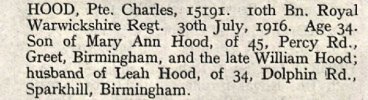
My Grandads Uncle was in the 10th Battalion during WW1. I believe this was one of the pals brigades. I often wonder what went through his head as he was in his 30s, with two small children, when he enlisted. He died at the battle of the Somme just about has his 3rd Child was born.
 

Attachments

  • Screenshot_20241230_175553_Ancestry.jpg
    Screenshot_20241230_175553_Ancestry.jpg
    68.4 KB · Views: 9
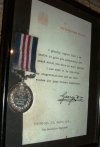
My Dad ( CH Taylor ) served with the Royal Warwickshire Regiment, initially, then was transferred to The Hampshire's, going from Africa across to Italy., where he was made up to Sgt, awarded the Military Medal for gallantry on the Italy Landings at Salerno. I have all the records APART from the CITATION, which can take two years to get a copy of ( I know, utterly ridiculous). Here is Dads MM. It does have the engraved edging, Name Rank & Serial number.

 

Attachments

  • DSCF7037.JPG
    DSCF7037.JPG
    479.1 KB · Views: 11
My Dad ( CH Taylor ) served with the Royal Warwickshire Regiment, initially, then was transferred to The Hampshire's, going from Africa across to Italy., where he was made up to Sgt, awarded the Military Medal for gallantry on the Italy Landings at Salerno. I have all the records APART from the CITATION, which can take two years to get a copy of ( I know, utterly ridiculous). Here is Dads MM. It does have the engraved edging, Name Rank & Serial number.
Fantastic thanks for sharing
 
My dear dad was on the "Salerno Landings", R A, he was badly wounded on day 2, by a n 88 shell burst, his comrades not surviving, picked up by the US 5th Army, medics, and spent 13 months in a US military hosp in Naples. He suffered the rest of his life with, bad nerves, and severe tinnitus, and later with walking problems, though he did live to 83.!!
 
Hi all this is my great grandfather 5111657 George Albert Gale
And I would love to find photos of him with his mates etc he fought in France then was evacuated from Dunkirk, went home to marry, and then died in Burma in 1943
Thanks for your help in adva1000022290.png
nce
 
Last edited:
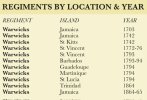
The St. Vincent involvement 1772-76 reported as used to subdue the Native Kalinago people and the British takeover of the Island.
Natives defended against British encroachment who wanted to expand their sugar plantations.

 
“In January 1773 a party of the 31st Regiment of Foot led by Ralph Walsh was ambushed and killed by Garifunas, becoming the highest-ranked loss of the war.

Despite their large numbers, disease and the hot and wet weather on the island led to many soldiers dying shortly after arrival, with half of the 14th Regiment's contribution having died before any fighting occurred. By the end of the hurricane season, much of the island's food stores were spent, and the expeditionary force was dependent on American food shipments. The roughly 1500-3000 Garifuna fighters lasted out the invasion through ambushes and attacks on plantations to starve out the expeditionary force”
(Three Continents, One History: Birmingham and the Transatlantic Slave Trade by Dr Clive C C Harris.)

 
Last edited:
Warwicks in Martinique 1794.

“In March 1794, the 6th Foot (Warwickshire) and the 64th Foot (Staffordshire) were among the regiments that landed on the strategically important island of Martinique. Not only would its capture destroy the morale of the French troops, and boost that of the British, but it would mean that French supplies would find it harder to get through to other colonies. Deprived of a naval base, it would be difficult for France to sustain a naval presence 5,000 miles from Europe let alone send reinforcements to defend its territories.”
(Three Continents, One History: Birmingham and the Transatlantic Slave Trade by. Dr Clive C C Harris.)
 
Warwicks in Guadeloupe 1794.

“A detachment of the 6th (Warwicks) was left behind for garrison duty before the Expedition headed north to take Guadeloupe, capturing Les Isles Saintes on the way. Guadeloupe was swiftly captured in a campaign that resulted in the loss of 15 men (and two missing). Both the 6th and 64th Foot sent two companies to Guadeloupe from among their ranks but the majority were garrisoned on St Lucia and Martinique, respectively.”
(Three Continents, One History: Birmingham and the Transatlantic Slave Trade by. Dr Clive C C Harris.)
 
Known, in British Army, as the white mans grave posting, Pedro!!

Still on 1794…
“Between March and October, 1794, the 6th Regiment's monthly returns, held in the War Ofice records in the National Archives, show that each month between 81 and 119 men were out of action due to sickness, some still in quarters but the majority severe enough to be admitted to hospital, while the report for June shows that, in just one month, 40 of its number had died. The 64th Foot fared worse: Before any swords had even been drawn, 348 men were already sick, leaving seven dead and just 212 present and fit for duty, while the returns for July 1794 show 84 dead and for September, 72……. it is estimated that 12,000 British men lost their lives in the Caribbean in 1794 alone.”
 
Some info can be gained from Wikipedia and the Fusilier Museum about the involvement in the Far East…

The 1st Battalion (Royal Warwicks) spent most of the war on garrison/internal security duties in India, then trained for jungle warfare and took part in the final stages of the Burma campaign (including the period around the capture of Rangoon/Operation Dracula in 1945).

Some “Warwickshire” units were re-roled into anti-aircraft / artillery formations and served in the Burma campaign (they still counted as Royal Warwickshire in lineage terms). Wikipedia notes, for example, that the pre-war 5th Battalion had been converted to an anti-aircraft unit and later served in Burma as part of 36th Indian Infantry Division.

There are also indications (from the regimental museum context) that some Royal Warwickshire soldiers became Chindits (the long-range penetration groups operating in Burma).

Individuals from the Royal Warwicks could certainly have ended up in other Far Eastern locations via attachments, postings, or transfers.
 
my dad was in the royal warks 39-66 18 at the time got wounded in Caen i would love to find out more about his time with the royal warwick`s but i don`t know where to start
 
Back
Top