• Welcome to this forum . We are a worldwide group with a common interest in Birmingham and its history. While here, please follow a few simple rules. We ask that you respect other members, thank those who have helped you and please keep your contributions on-topic with the thread.

    We do hope you enjoy your visit. BHF Admin Team

Jordan's Grave - New Oscott

Lady Penelope

master brummie
I've been researching Jordan's Grave for some time and theories abound as to what it is and who Jordan was. He could have been a highwayman, hung on the gibbet just down the road, a self-murderer/suicide (buried at the crossroads with a stake through his heart) or maybe a gypsy interred at a wayside burial? Could it just be a nickname assigned to a pile of stones put there to mark the boundary and meeting point of two counties (Staffs & Warks) and three parishes (Perry, Sutton and Erdington)? These are just a few of the options.

In 2017 Astoness drew my attention to the thread below but although I've tried several times I haven't been able to access it.
hi pen the last post on this thread is interesting..
https://birminghamhistory.co.uk/forum/index.php?threads/jordans-grave-oscott.28536/

I know that the 'grave' was marked on maps from at least the middle of the 1600's and that William Dugdale felt it important enough to mention in his 'Antiquities of Warwickshire'. However, that's all he did - mention it - no details unfortunately.

It's probably now in the grounds of St Mary's College which was built in the 1830's and around the time that the name Beggars Bush first appeared up the road. I have applied for permission to take photographs of the area but this hasn't been granted yet.

Any help, newspaper cuttings, information would be really appreciated please.

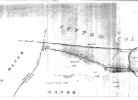
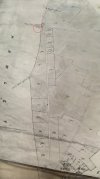
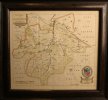
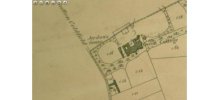
I've attached some maps for location one of which I used when researching Baldmore Lake.
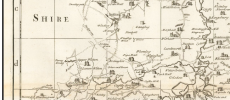
Beighton's map.pngSketch Pre-1801.jpgJordans Grave on Enclosure Map.jpgSpencer Image.jpg
 
The first mentions in the papers that I can find are in the Sutton Coldfield inclosure of 1826 and 1827.

“A place called Jordan’s Grave which separates the hamlet of Erdington from the manor of Perry Barr.”
 
hi pen a friend of mine mentioned he had seen a map with jordans grave marked on it and wondered who he was and i said i am sure there is something on the forum which of course led me to your thread...just wondering if you ever got to take photos of the area? also here is map dated 1848 showing jordans grave

lyn

thumbnail - 2025-05-06T164101.595.jpg
 
Last edited:
1826 mentions of Jordan's Grave.
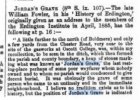
Inclosure of a piece of waste land on the coldfield, beginning at the entrance of the common, near the Bell and Cuckoo, and extending on the SW side of the old Chester Road to Jordan's Grave, on the Perry Barr Road.

In 1895 an article in the Warwickshire Herald say that a gibelt stood near Oscott College on which a highway man was hung for killing a peddler named Jordan. The proper name of the site of The College was Jordan's Grave, his remains having been discovered when the college was built.
 
Hi Lyn, I've been researching this along with Gibbets Hill and Beggars Bush. All within a few hundred yards of each other. There are many stories about who Jordan was and why his grave is there. I think this may be the origin of the beggar of Beggar's Bush. However, I think it's a signpost showing the way to Anglesey and North Wales, Sutton Coldfield and London.

Also the Chester Road was a drover's road so coming from Wales the drovers would turn right at the 'grave' taking them to market in Birmingham.

Another possibility is that as the 'grave' was marked by a pile of stones (seen by a friend on a visit to the college 20 years ago) and is on a gypsy route as gypsy were shown camping on the Coldfield on the 1851 census and usually kept to known routes.. It may have been a marker for those that followed.

It's near to the boundary between Perry Barr, Sutton and Erdington although this has changed slightly. This area was a wild and lonely place.

Any input welcome.

Penny
 
Hi Penny, see post #8 by Pedrocut, he posted about the same time as you, its a very interesting post.
 
1826 mentions of Jordan's Grave.
Inclosure of a piece of waste land on the coldfield, beginning at the entrance of the common, near the Bell and Cuckoo, and extending on the SW side of the old Chester Road to Jordan's Grave, on the Perry Barr Road.

In 1895 an article in the Warwickshire Herald say that a gibelt stood near Oscott College on which a highway man was hung for killing a peddler named Jordan. The proper name of the site of The College was Jordan's Grave, his remains having been discovered when the college was built.
Great bit of research Pedrocut, im a nosey so and so , id love to know the source of the 1826 mention of Jordans grave. Cheers Max
 
I can confirm that the earliest mention of Jordan's Grave that I've come across is on the map drawn by Beighton in 1725. He was apparently a very thorough surveyor and didn't rely on earlier maps which others had done before. This map pre-dates theories which I've come across many of which seem to rely on hearsay.
 
lady P I believe Bill Dargue… Earliest printed mention is on William Dugdale’s Antiquities of Warwickshire (1656) map. The name later appears in 18th/19th-century descriptions and inclosure records.
 
Pedro, I couldn't find it on Dugdales First edition in Sutton Library only on the second edition but these are, if course, copies. Good to know that it's even earlier. Thanks.
 
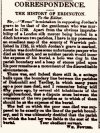
In the Warwickshire Herald of 1885, W Fowler informs…

View attachment 169808

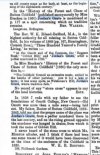
This is what Fowler says about Jordan’s Grave in his address to the Erdington Institiute in 1885…

A little further to the north, and only a few yards from the Chester Road, very near to the site of the gasworks at Oscott College, was within my recollection to be seen, in the ditch which then formed the parish and county boundary, a heap of stones marking what was known as "Jordan's Grave," the last resting-place perhaps of some poor wayfarer whom nobody owned, and to whom no parish would condescend to give decent burial. It was obviously the grave of some person who came to an untimely end in the immediate neighbourhood.
I believe no tradition exists as to his history, but the position of "Jordan's Grave" is indicated on old county maps as far back, at least, as the beginning of the eighteenth century.

It was the custom in former days to hang murderers and highwaymen as near as possible to the scene of their crimes, and to leave their bodies hanging un the gallows, and I very well remember in my early days seeing the stump of a gibbet remaining on the high ground between Boldmere Church and the Beggar's Bush, still known as "Gibbet Hill." The gibbet was, I believe, erected in 1729, in honour of the murderer of a silk dyer from London, who was robbed and murdered in the immediate neighbourhood.
There are several other gibbets in this neighbourhood, marked upon ancient maps: for instance, Allport's Gibbet, near the Parson and Clerk, and Power's Gibbet, near Bassetts Pole.
 
Back
Top