• Welcome to this forum . We are a worldwide group with a common interest in Birmingham and its history. While here, please follow a few simple rules. We ask that you respect other members, thank those who have helped you and please keep your contributions on-topic with the thread.

    We do hope you enjoy your visit. BHF Admin Team

Erdington in the 18th and 19th century

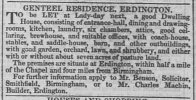
The above clip shows that Charles was builder of dwelling in Erdington within half a mile of the Chapel.

Back in time the Erdington faithful had to travel to Aston parish Church. A south aisle was added “Erdington Chapel” inside the Church.
A new chapel of ease, High Street, was consecrated in 1824 and called Erdington Chapel. In 1858 it became a district chapelry and the Parish Church, over time became known as St Barnabas.

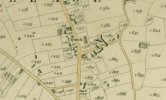
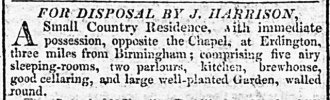
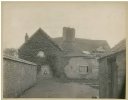
This is a clip from 1823 of a building opposite the Chapel. Theoretically this could appear on the Tithe Map, and maybe… ??

IMG_0238.jpeg

IMG_0227.jpeg
 
Last edited:
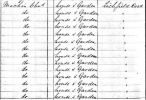
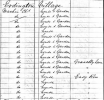
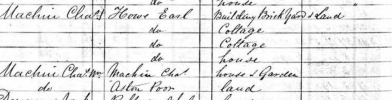
Not sure if this answers any questions but 1865 rates book shows Charles Machin owning property in Erdington Village
1765467177718.png

1765467226933.png
But also renting building and brickyard owned by Earl Howe
1765467299657.png
 
Last edited:
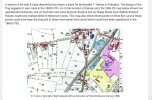
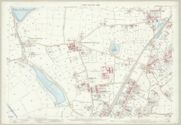
Is it just also coincidence that there's kilns/brickworks at the back of the "Easy Row" named cottages? There were 3 kilns still showing on the c1880s map

Could have got the wrong end of the stick here, or not processed all the info pouring out on this one, but couldn't the Chapel have been St Barnabas Chapel of Ease (or similar as I think it was named in the 1820s)? Prepared to be shot down in flames on this one !
 
Last edited:
I assumed it was that brickworks - hadn't seen another one.
I also thought it might mean St Barnabas Chapel but wasn't sure

Will check rates book but think it only says Erdington Village

If you look at post#467 there are properties listed under Easy Row and then the brickyard but no actual road listed.
 
Last edited:
It is confusing and I think it is just the way the Chapel was referred to in local adverts and reports. It was certainly dedicated to St Barnabas when it was built in 1822/4 as the Chapel of Ease, after being the “Erdington Chapel” within Aston Parish Church. They just kept referring to it as Erdington Chapel or just the Chapel.
I am not sure when the proper name came into general use, but Erdington became a separate parish in 1858, and it was down as St Barnabas in Showell’s Dictionary in 1880s.
 
Apparently, there were two operational brickworks in the area to the west of the High Street. It's unconfirmed, but one might have belonged to Haines, the other unamed according to this extract from the British Bricks site. Of the two, and wildly speculating on this, I'd say the one by Summer Lane (later Summer Road) is a contender.

As I originally understood it, Machins brickwirks wasn't a very large concern, at least not on the scale of Nocks. And considering Machin's building/property development interests too, how convenient that brickworks would have been for Erdington housebuilding at a time of significant expansion of Erdington Village.

Screenshot_20251211_191311_Chrome.jpg
 
Last edited:
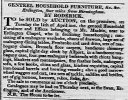
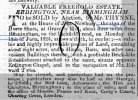
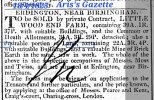
Here is a report from 1825 about a highly improvable portion of land….with a profitable brick-kiln establishment attached to the same, situate opposite Erdington Chapel, occupied by Edward Twiss.

So it looks that in 1825 it was on lease to Twiss by the Earl Howe.


IMG_0244.jpeg
 
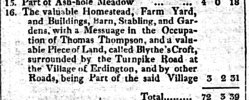
Was the Brick Mine on the land of Little Wood End Farm (Moss and Twiss) ? If so, where was Wood End Farm ? It was in Erdington, but where ? Interesting that a London office was handling the sale contract. Not sure what the numbers relate to (29P, 22A etc - land measurements? acres, perches, rods?)
Screenshot_20251211_200508_Chrome.jpg
Source: British Newspaper Archive
 
Last edited:
The existance of most of the Erdington churches/chapels listed on Midland Ancestors fall outside the time frame that we're interested in (c1820s). I've extracted these from the site purely on the basis of their existance in the early to mid part of the 19th century, there is nothing listed for earlier periods. At this time, most worshippers would have travelled to Aston.

St Barnabas seems to be the only one serving Erdington at that time, although the Congregationalists had services in 1814 in a building in Bell Lane (which became Orphanage Road) but there's no mention of a chapel. There was a Baptist Chapel at Six Ways, which was near Wood End Lane, but I think this opened in the 1870s.

C of E: St Barnabas High Street Consecrated 1824.as a chapel of ease to St Peter & St Paul, Aston

Congregationalists and Independents High Street : Chapel was built in 1839. Congregational services began at Erdington in 1814, in a building in Bell Lane Erdington, used in later years as a Roman Catholic chapel.

St Thomas & St Edmund of Canterbury The Abbey Sutton Road : A chapel in Bell Lane, was said to have been built in Erdington c.1839. In 1842 a school chapel was opened. A new church was begun in 1848 and consecrated in1850.

Methodists – Erdington
Orphanage Chapel was from 1862 – 8 a Wesleyan ‘preaching place’. Services were held in the small hall of the Erdington Almshouses founded by Josiah mason, and used until 1868, as the temporary homes of the Josiah Mason orphanage.

Also from the site, and by way of a potentially interesting link is this quote about Earl Howe who gifted much of the land etc. associated with St Barnabas Chapel/Church

"...the land, including the churchyard, the site of schools, and parsonage-house, was the gift of Earl Howe, the Rev. G. Peake, and the Rev. J. H. Harrison"

 
Last edited:
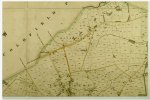
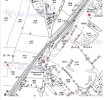
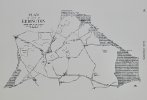
This is a bit hard to read. It is a sketch from the Birmingham Archaeological Society of the Erdington enclosure in 1801.

It is possible to make out some of the present day roads.

IMG_0254.jpeg
 
(Old) Green Man centre (bottom) on Bromford Lane ? (Now Lad in the Lane). So Kingsbury Road going horizontally above that ?
 
Last edited:
Back
Top